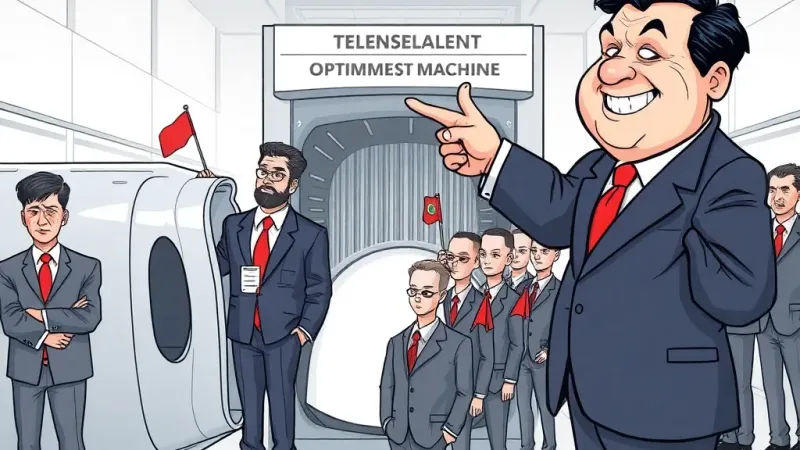
Kinshasa, DRC – The Democratic Republic of Congo's Ministry of National Cohesion today announced a groundbreaking "Political Talent Optimization and Strategic Redeployment Initiative" designed to more effectively utilize the skills of opposition figures. The program, lauded by government spokespersons as a leap forward in national unity, aims to redirect the energy and potential of dissenting voices into channels more conducive to the nation's "harmonious development." Details remain scarce, but officials suggest the initiative will involve comprehensive individual assessments and tailored placement processes.
"We recognized that our political landscape contained a wealth of untapped potential, particularly among those who, perhaps, needed a stronger sense of direction," explained Dr. Patrice Lumumba II, Director of the newly formed Department of Ideological Integration. "Instead of allowing valuable human resources to become, shall we say, unproductively critical, we are offering bespoke opportunities. Think of it less as a political reshuffle and more as a highly specialized corporate HR strategy – identifying key players and ensuring they're in the right 'silent partnership' for maximum national output." Dr. Lumumba II highlighted a pilot program that has already seen a 100% "retention rate" among its participants, who are reportedly no longer engaged in public dissent.
The initiative includes various "re-skilling camps" located in strategically remote regions, offering workshops on topics like "Consensual Governance Messaging," "National Priority Alignment," and "The Benefits of Self-Censorship in a Developing 2." Participation is reportedly not optional for individuals identified by the National Cohesion Council as possessing "high-potential for disruptive engagement." A leaked internal memo, marked "Level 4 National Harmony Critical," detailed a metric called "Public Discourse De-escalation Coefficient," which measures the rate at which vocal opponents transition into less visible, non-disruptive roles. The target, according to the document, is an average annual reduction of 15-20% in "unsolicited public political contributions."
International observers have cautiously welcomed the program, with a spokesperson for the 'Global Institute for Democratic Development' noting, "While the optics of 'strategic redeployment' may raise some eyebrows, any initiative that purports to foster dialogue and provide career pathways for politicians should be given the benefit of the doubt. We look forward to receiving the DRC's comprehensive impact report, particularly the testimonials of those who have successfully completed the program, assuming they can be reached for comment." The institute did not specify what "reached for comment" might entail in this context.
Critics are reportedly still formulating their concerns, though their official statements have become noticeably more concise and significantly less public.