
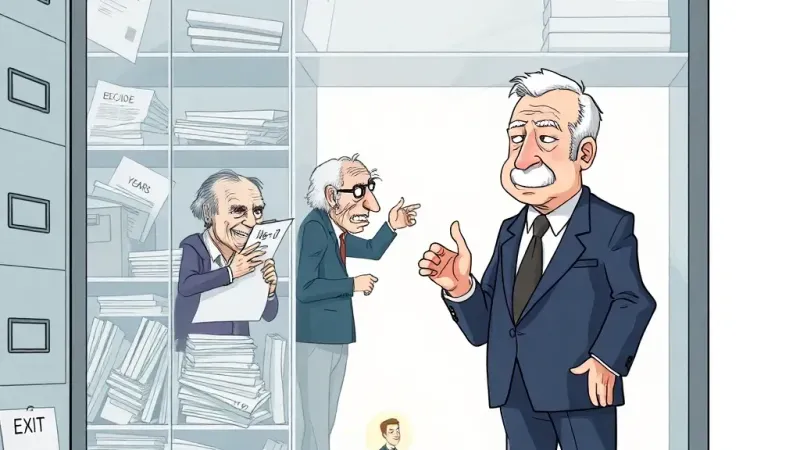
Government officials have unveiled a new "National Loyalty Retention Initiative" designed to make the process of renouncing citizenship a uniquely challenging, multi-decade personal growth journey for any citizen considering departure. The program, which replaces the former "labyrinthine administrative nightmare" process, is expected to dramatically reduce the number of successful renunciations by extending the typical timeline to an estimated 35-40 years.
Under the new guidelines, individuals seeking to relinquish their ties must complete an initial "Intent to Depart" form, which then triggers a mandatory 15-year "Cooling Off and Reconsideration Period." During this period, applicants are required to submit quarterly "Proof of Continued Domicile" filings, undergo annual "Patriotism Enhancement Workshops," and are automatically enrolled in a state-sponsored "Cultural Re-Integration Mentorship" program. This mentorship pairs them with a randomly assigned senior citizen who provides weekly 'historical context' lectures via teleconference, often covering the precise historical periods where renouncing citizenship was strictly forbidden.
"We believe this new, streamlined approach truly respects the gravity of citizenship," stated Pavel Kuznetsov, Deputy Director of the Bureau of Perpetual Allegiance, in a recent press briefing. "It's not about making it impossible; it's about ensuring every single person who leaves truly understands the lifelong commitment they're making to *not* be a citizen anymore. It’s a transformative journey, much like earning a PhD, but without the benefit of a clear path or a recognizable end goal." Kuznetsov added that early data suggests a 98% attrition rate for applicants within the first three years of the "Cooling Off" period, primarily due to "form fatigue" and "2."
The initiative also introduces the "Ancestral Linkage Verification" phase, requiring applicants to trace and document their lineage back at least six generations, proving no ancestor ever renounced citizenship, thereby establishing a "clean slate" for their own attempt. Any historical defection within the family tree, no matter how minor or apocryphal, automatically resets the entire application process to phase one. Historians have noted that this phase alone has proven insurmountable for approximately 78% of applicants, many of whom simply give up after their third attempt to locate 18th-century birth records from a now-nonexistent village.
Furthermore, a new digital portal, "The Great Exit," has been launched. While ostensibly designed to simplify submissions, it currently requires all forms to be uploaded as encrypted PDFs, then physically printed, hand-signed in triplicate, scanned back into a JPEG, and finally uploaded again—often to a perpetually "beta testing" interface that frequently crashes and deletes all progress without warning, sometimes requiring applicants to re-enter their entire multi-decade history from scratch. IT specialist Dr. Anya Sharma, who consults on digital bureaucracy, noted, "The portal's primary function appears to be instilling a profound sense of digital futility, a critical skill for navigating modern state systems."
The program has drawn criticism from international human rights organizations, who argue that the new measures effectively render citizenship renunciation impossible for the vast majority. However, state media outlets have lauded the initiative as a "bold step" towards strengthening national identity and ensuring that "only the truly dedicated, or perhaps the perpetually unemployed, will have the time and resources to complete the rigorous, albeit rewarding, process of severing ties."
The final step, the "Ceremony of Severance," reportedly requires applicants to correctly answer a series of unanswerable philosophical riddles posed by a state-appointed mystic, or simply wait until their original passport expires, whichever comes first, a process that officials confirm could take "anywhere from a lifetime to several."