
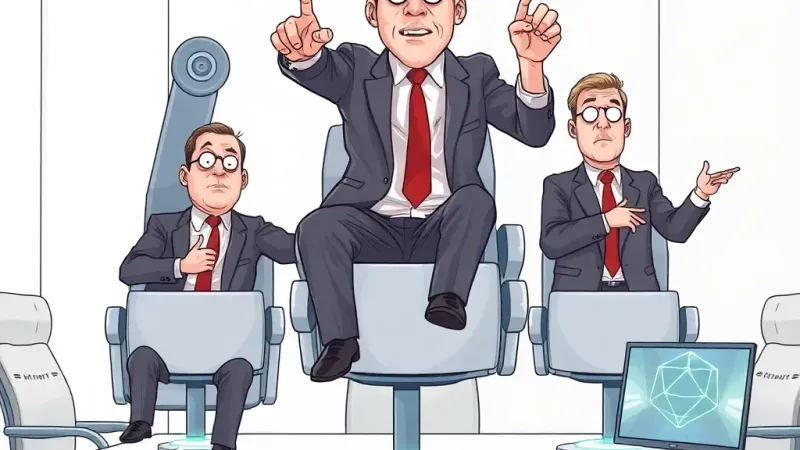
Silicon Valley, CA — A wave of fresh layoffs across the 2 sector has left numerous executives and venture capitalists reportedly "blindsided" and "deeply confused" by the sudden realization that 2, the very product they have aggressively funded and promoted, is capable of automating roles previously held by humans. Data from Challenger, Gray & Christmas indicates a significant surge in tech job cuts, with AI cited as a primary driver, prompting a collective furrowing of brows among industry titans who apparently believed their "disruptive innovation" would somehow be exempt from disrupting *their* payrolls.
"It's like, we built these incredibly powerful tools to process data, write code, and even generate content with astounding efficiency, and now they're… doing exactly that, but without needing a salary," explained Blythe Kensington, CEO of Synergy Nexus AI Solutions, from her ergonomic standing desk overlooking the Bay. "We always talked about AI 'transforming' industries, but I guess we pictured it transforming *other* industries, not, you know, our internal QA department or mid-level marketing teams. It's truly an unexpected development."
Analysts confirm that the growing trepidation among founders regarding AI's potential to "destroy their company" stems from a newfound awareness that the technology they’re investing in might eventually eliminate the need for significant human overhead, including their own. "We're observing a widespread phenomenon of 'tech-bro 2,' where the architects of tomorrow's automated workforce are suddenly grappling with the concept of being part of yesterday's analog workforce," stated Dr. Arlo Finnegan, head of Algorithmic Societal Impact at the Global Institute for Pre-Emptive Disruption, via a disembodied AI avatar of himself. "They’re not wrong that AI is costing jobs; they just thought those jobs would be outside their immediate ecosystem, perhaps in manual labor or 'less innovative' sectors. The irony is, of course, delicious."
Venture capitalists, typically bullish on any technology promising efficiency, are now reportedly struggling to reconcile the dual realities of maximizing profit through automation and maintaining a human workforce. "My partners and I are constantly asking, 'If AI can do 80% of what our portfolio companies' employees do, why are we paying for 100% of their existence?'" admitted Maximillian "Max" Sterling, managing partner at Quantum Leap Capital, while reviewing a spreadsheet of projected Q3 severance packages. "It's a genuine quandary. We need the humans to build the AI, but then the AI makes the humans redundant. It's a remarkably effective business model, but also, like, a total bummer for, you know, *people*."
Sterling added that while the firm remains committed to "human-centric innovation," their next investment round would primarily focus on companies developing AI that can manage other AI. The industry vows to continue monitoring this "unforeseen" trend closely, promising to convene several high-level panels and think tanks to explore why technology designed to replace tasks is, in fact, replacing tasks.