
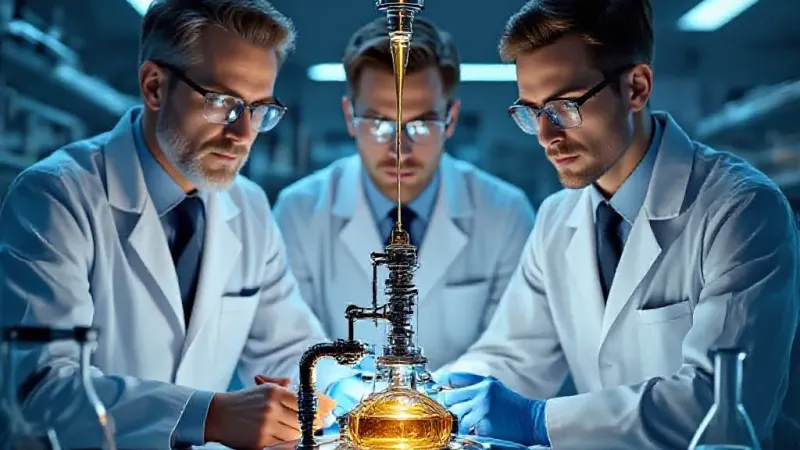
WASHINGTON D.C. — In a move widely praised for its commitment to exhaustive due diligence, the Biden administration today announced a multi-year, $30 million feasibility study into whether banning U.S. diesel exports would have any discernible impact on global energy markets or, for that matter, the price of gas at American pumps. The undertaking, led by senior energy advisor Amos Bessent, follows former President Donald Trump’s recent public endorsement of such a ban.
"When a prominent public figure makes a suggestion, however outlandish, it is our duty to scientifically ascertain whether the laws of economics, supply, and demand suddenly cease to apply," stated a visibly fatigued Bessent during a press conference where he continuously adjusted his tie as if it were a noose. "Our initial hypothesis, based on centuries of human civilization, is that restricting a major global energy supply might, potentially, alter said global energy supply. But we refuse to operate on mere intuition when millions of taxpayer dollars can confirm this hunch."
The study, dubbed "Project: What If?" will reportedly involve a team of 40 economists, geopolitical strategists, and a high-school student who correctly identified which way the gas pump arrow points. Their mandate is to meticulously analyze scenarios where a sudden removal of U.S. diesel from international markets could lead to anything from price volatility to widespread geopolitical instability. "We’re really diving deep," explained Dr. Evelyn Reed, lead project manager for the study. "Like, what if other countries, who currently rely on our diesel, just… didn’t have it anymore? What would they do? Would they be, you know, upset?"
Anonymous sources within the Department of Energy indicated that the preliminary phase of "Project: What If?" includes reviewing kindergarten-level supply-and-demand charts and a comprehensive re-reading of Adam Smith’s *The Wealth of Nations* to ensure no basic economic principles have secretly changed overnight. "It’s like being asked to research if water is wet because someone influential tweeted that it might actually be dry on Tuesdays," one analyst confided, requesting anonymity for fear of being reassigned to study the feasibility of flat earth theory.
The administration defended the expenditure, noting the critical importance of rigorously validating every spontaneous utterance from former executives. "We can’t just *assume* that when you stop selling something valuable to the world, the world will react," a White House spokesperson explained, clutching a stress ball shaped like a barrel of crude oil. "We have to run the models, crunch the numbers, and possibly even construct a small, working model of the global economy out of Legos, just to be absolutely sure."
The study is projected to conclude sometime in late 2027, by which point global energy markets will either have completely collapsed or spontaneously rearranged themselves according to an entirely new, currently unknown, set of physics, proving the White House’s foresight in launching the study.