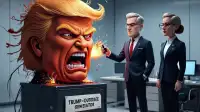
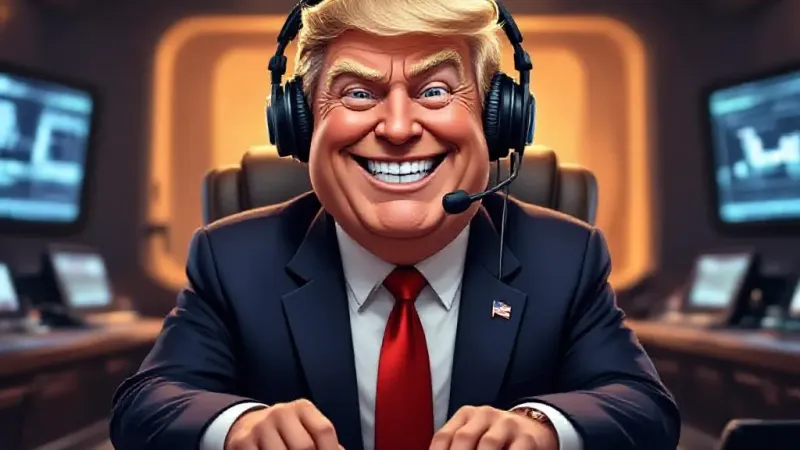
Washington D.C. — What began as a principled stand against a former president has officially been reclassified by industry observers as his most potent public relations strategy to date. Major television networks' much-touted "boycott" of Donald J. Trump has, according to internal analyses and his own candid remarks, evolved into an unintentional, yet highly effective, vehicle for maintaining his omnipresence.
Sources close to the former president confirm his long-held belief that "they never boycott me" isn't a delusion, but a profound understanding of the modern media landscape. "He sees every segment discussing why they *aren't* showing him, every pundit dissecting his latest non-appearance, as just more screen time," explained one aide on condition of anonymity. "For him, a headline screaming 'Networks Refuse to Cover Trump' is just as good, if not better, than 'Trump Delivers Speech.' It’s all engagement, all oxygen. They think they're starving him, but they're just changing the flavor of the meal."
Dr. Evelyn Thorne, director of the Institute for Aspirational Proximity Studies, stated the phenomenon is no longer ignorable. "When a network 'boycotts' a public figure, but then dedicates three prime-time hours to discussing *the boycott itself*, what have they truly achieved? They’ve simply shifted the narrative from 'what Trump said' to 'why we’re not showing what Trump said,' ensuring the figure remains central to the conversation. It’s a parasitic symbiosis where the host keeps feeding the parasite while loudly complaining about the parasite, effectively performing a public service announcement for the 'boycotted' individual."
This strategic reclassification comes as several rival politicians have reportedly begun demanding similar "boycotts" from major outlets, hoping to replicate Trump's success. "My campaign manager wants me 'boycotted' by CNN next week," lamented one struggling gubernatorial candidate who asked not to be named. "Apparently, it’s the only guaranteed way to get more than two minutes of airtime these days. If they ignore you on purpose, that's the new gold standard for visibility. Actual policy discussions? Forget about it. Just threaten to run, get 'boycotted,' and watch the impressions roll in."
Industry analysts agree the media, in its earnest attempts to reclaim journalistic integrity or simply appeal to a specific audience, has fallen into an inescapable trap. "The incentive structure is perverse," explained a network executive who requested anonymity to avoid being next on the "boycott" list. "We *need* the ratings. And sadly, a heated panel debating why we *shouldn't* cover Trump often pulls more eyes than a sober report on infrastructure. We're caught between our stated principles and our quarterly earnings. And Trump, bless his self-serving heart, understands this better than any focus group."
Ultimately, experts agree the "boycott" has proven to be an elaborate, self-defeating pantomime. The real metric for Trump, they note, has always been engagement, not approval. And by framing their disengagement as a moral imperative, networks inadvertently provided the ultimate engagement hook: controversy over absence.
The only true boycott, according to Dr. Thorne, would be if the networks truly forgot he existed. "But that, it seems, is an impossible ask in an attention economy where even silence must be loudly announced to register as significant."