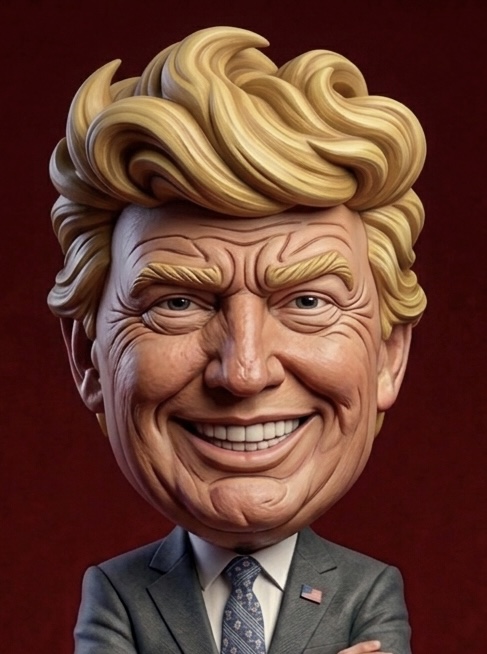
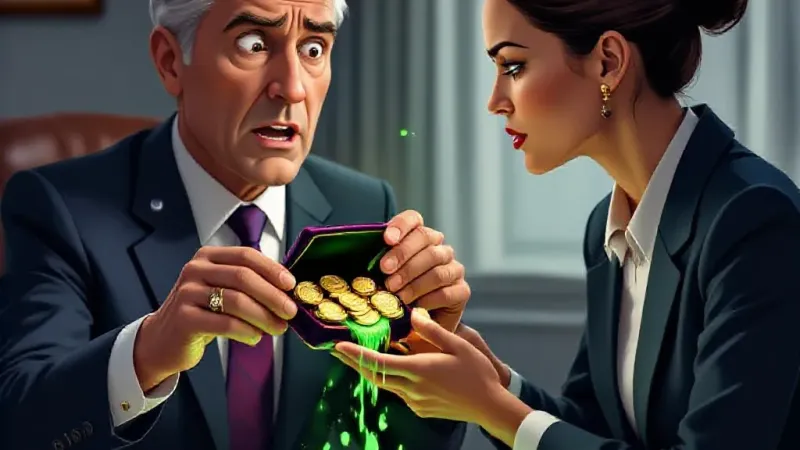
A new market advisory from the Institute for Asset Toxicity Studies (IATS) warns that any hypothetical U.S. currency bearing the image of former President Donald Trump could represent a unique and unprecedented financial liability for collectors. This stark revelation follows a recent market trend where a rare, slightly damaged 26-cent coin fetched nearly $17,000 at auction, dwarfing the predicted market value—or more accurately, the projected net cost—of any politically divisive commemorative currency.
Dr. Sterling Gold, chief market analyst at IATS, released a white paper detailing what he termed the "Trump Coin Paradox." "Traditional collectibles appreciate or depreciate based on rarity, condition, and historical significance," Gold explained to a virtual conference of bewildered numismatists. "However, our advanced predictive models show that a Trump-branded coin introduces an unprecedented 'negative social equity' factor. Its acquisition doesn't merely imply a lack of resale value; it carries a built-in depreciation that is not just zero, but actively punitive." Gold's research cited empirical data indicating that merely possessing such an item could lead to increased social friction, higher insurance premiums for "controversial assets," and even unforeseen storage costs associated with hazardous material disposal.
The IATS report advises potential inheritors of such hypothetical currency to consult financial advisors immediately, urging them to consider the "proactive liquidation of all related assets." "We're not just talking about a lack of appreciation or a stagnant investment," said Gold, adjusting his monocle. "We're projecting market forces where the cost of finding a buyer, the associated emotional labor of justifying its existence to friends and family, and the potential for a social credit score deduction could render the item a net drain on an individual's total wealth portfolio." He noted a recent IATS market simulation where a perfectly preserved, mint-condition hypothetical Trump quarter generated a market bid of negative $0.37, meaning sellers would literally have to pay a prospective buyer 37 cents just to take it off their hands.
Local coin dealer, Barry "The Bullion" Jenkins, 54, of Lincoln, Nebraska, echoed the sentiment, shaking his head slowly while polishing a genuine 1913 Liberty Head nickel. "Look, I’ve seen some bad investments in my time," Jenkins mused. "Beanie Babies, NFTs of a guy’s digital toe, even a few Confederate dollar bills from a particularly ill-advised estate sale. But a Trump coin? That’s like buying a cursed relic with negative equity built into the curse. You can’t even melt it down without people asking why your furnace suddenly smells like entitlement and poorly-sourced spray tan." Jenkins added that his shop now charges a "political toxicity surcharge" for appraising any item even tangentially related to recent presidential administrations.
The IATS study concluded that the safest long-term financial strategy for anyone encountering a Trump coin would be to immediately report it as a theft, then claim emotional distress damages from the alleged perpetrator. This, according to Gold, would be the only plausible scenario for such an item to generate a positive return for its theoretical owner, marking a groundbreaking moment in numismatic history.