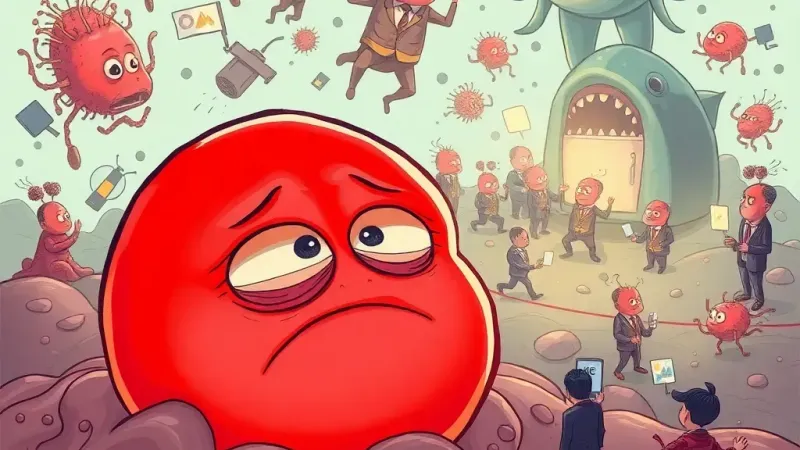
A new study on ancient "elephant skin" rock formations in Morocco has revealed that Earth's earliest life forms managed to thrive in deep, dark ocean environments without any discernible capital infusion or projected Return on Investment (ROI), challenging a foundational tenet of modern evolutionary biology.
Researchers from the University of Fes-Saïss were reportedly "floored" to discover that microbial ecosystems flourished in chemically-fueled abyssal conditions, completely devoid of market analysis, competitive landscape assessments, or even a basic pitch deck. "For centuries, we’ve operated under the assumption that for any organism to achieve sustained cellular replication and eventual multi-kingdom diversification, it would first need to secure a Series A round, demonstrate product-market fit, and articulate a clear exit strategy," explained Dr. Aris Thorne, lead paleontologist and head of the newly formed Institute for Pre-Seed Biological Innovation. "We’d envision these early ecosystems constantly fundraising, pivoting, and burning through resources. Turns out, ancient bacteria just… did it. With some rocks and methane, a total lack of mentorship, and absolutely no networking events."
The findings suggest that countless similar "pre-VC" life forms have likely been overlooked or misinterpreted, as previous scientific models implicitly prioritized evidence of environments conducive to traditional funding cycles, such as sunlit shallows with high perceived customer acquisition potential. "It's a classic case of observer bias," noted Dr. Thorne. "We were looking for the Silicon Valley of primordial oceans – vibrant, well-lit, and constantly announcing new partnerships. Instead, we found a flourishing, sustainable 2 operating entirely in the dark, fueled by chemical runoff from underwater landslides, which, frankly, sounds a lot like most modern startups."
This paradigm shift has prompted a seismic reevaluation of evolutionary pathways, forcing biologists to confront the unsettling possibility that complex ecosystems might develop and persist for eons without ever demonstrating exponential user growth, navigating complex regulatory frameworks, or signaling acquisition targets to maximize shareholder value. The implications extend beyond paleontology; some pundits are already suggesting that if primordial life could innovate and scale without a designated CEO, perhaps modern corporations could, too. "It’s a difficult truth to swallow," Dr. Thorne admitted, "that perhaps the universe doesn't always operate on a 'move fast and break things' ethos. Sometimes, it just moves slowly and builds things, then somehow manages to survive for billions of years on nutrient-rich detritus and sheer, unadulterated stubbornness."
"While the ancient microbes clearly exhibited remarkable resilience and unprecedented self-sufficiency," the study concludes, "none have yet announced a successful IPO or expressed interest in becoming a unicorn."