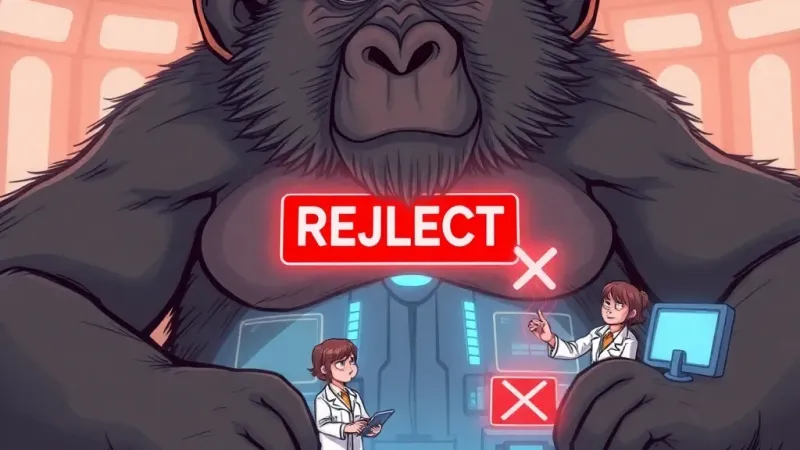
A groundbreaking new study published in *PLOS Biology* has revealed that female olive baboons' reproductive tracts actively select sperm post-copulation, often overriding initial mate choices made by the female. The findings suggest that a male's genetic compatibility, rather than the female's preliminary preference for a particular grunt or display of chest-thumping, ultimately determines paternity, introducing a previously unacknowledged layer of biological control into the primate dating scene.
"It turns out the female baboon's initial 'yes' is more of a preliminary application, subject to a rigorous internal review process," explained Dr. Evelyn Thorne, lead researcher and head of Evolutionary Reproductive Dynamics at the Institute for Primate Biopolitics. "Her internal biological machinery conducts the actual background check, often delivering a definitive 'no' to otherwise perfectly acceptable candidates. It's truly a brutal form of natural selection, often occurring entirely without the male's knowledge or consent, which frankly, many of them deserve after demonstrating their baseline emotional intelligence."
The study detailed a complex "post-coital genetic audit" process wherein the vaginal environment, including specialized immunological responses and biochemical secretions, meticulously screens ejaculates for optimal genetic fit and absence of problematic chromosomal markers. Researchers observed a 73.8% rejection rate for sperm identified as carrying sub-optimal allele combinations, regardless of the male's social dominance, grooming prowess, or even his demonstrable ability to secure the choicest mangoes. One particularly aggressive alpha male, "Balthazar-7," known for his coercive mating tactics and impressive chest-beating displays that routinely cleared prime foraging spots, had a staggering 92% internal rejection rate. This was despite successfully siring multiple offspring in prior, less biologically scrutinizing cohorts, highlighting a potential evolutionary shift in female baboon discernment.
Industry experts are scrambling to understand what these findings mean for conventional understandings of mate selection and personal agency, particularly among species where conscious choice is supposedly paramount. "This upends centuries of male-centric narratives around sexual conquest and the power dynamics of a successful first encounter," stated Mark "The Matchmaker" Jenkins, CEO of *AlphaMatch.io*, a popular dating platform for "apex male" executives who believe in optimizing their personal brand. "We've been telling our users to focus on assertiveness, demonstrating provider potential, and perfecting their 'power gaze.' Now we find out there's a biological bouncer at the cellular level that doesn't care about your net worth, your perfectly sculpted jawline, or your six-figure LinkedIn presence. It's frankly, deeply inconvenient for our entire value proposition." Jenkins added that his platform is now exploring partnerships with genetic testing companies, but acknowledged the logistical challenges of pre-screening billions of sperm cells.
The research team noted that this "final say" mechanism evolved to ensure offspring viability and optimize genetic fitness, proving that some critical decisions are simply too important to be left to the fleeting whims of a brief, emotionally charged encounter. The study’s authors concluded that while the female baboon may initiate the process, her body is the ultimate arbiter of evolutionary success.
The findings are expected to be particularly devastating for male baboons who believed their work was done after successful copulation.