A groundbreaking new study published by the Institute for Ecological Irony has revealed that what humans praise as 'wondrous' animal adaptations are, in fact, merely cruel evolutionary demands made by an indifferent and often hostile planet. The research debunks the long-held myth that complex biological traits signify nature's benevolence, asserting they are instead desperate measures for survival against overwhelming odds that only seem impressive because the alternative was immediate, painful death. Far from signs of a loving creator, these 'innovations' are purely the biological equivalent of being backed into a corner.
Dr. Vivian Thorne, lead researcher at the Institute for Ecological Irony, elaborated on the findings. 'When we marvel at a deep-sea anglerfish glowing in the abyss, attracting prey with its own horrifying, bioluminescent face-lantern, we think, 'how magnificent!' What we should be thinking is, 'this creature lives in total darkness, under crushing pressure, in an environment so devoid of food and mates that it had to evolve a personal light-up death-trap just to avoid starving alone.' It’s not a marvel of design; it’s a cosmic punchline delivered by a universe that really doesn't care if you're comfortable.'
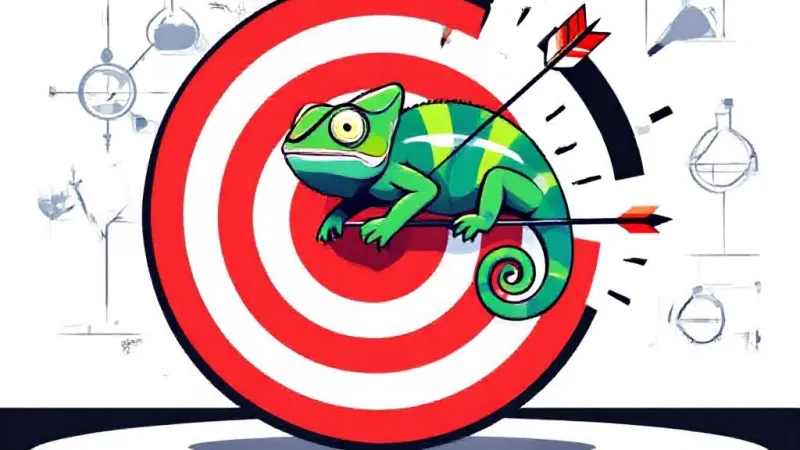
The study further dissects famous 'adaptations' across the globe. Take the chameleon, celebrated for its color-changing abilities. 'It’s not showing off; it's desperately trying not to be eaten by everything bigger than it, every single second of its fragile existence,' Dr. Thorne added. 'Or consider the arctic fox, changing its coat with the seasons. That's not a fashion statement; that's literally putting on a costume to avoid being spotted against the snow or the tundra, all while battling temperatures that would freeze a human solid in minutes. These are not choices; they are ultimatums from a brutal landlord.' The research suggests human encroachment and climate change are now accelerating these 'cruel jokes,' forcing species into ever-more desperate biological contortions just to maintain a foothold.
The paper argues that humans, with their relatively cushy existence, misinterpret these survival mechanisms through a lens of privileged wonder. 'We see a lizard that can regrow its tail and think, 'wow, regenerative medicine!' The lizard, however, is simply thinking, 'thank god, another day where I escaped a predator by leaving a piece of myself behind, again.' There's no celebration for the lizard, just the grim prospect of having to do it all over tomorrow,' Thorne explained. The researchers hope their work will shift human perception from anthropocentric awe to a more realistic understanding of the brutal mechanics of natural selection, especially as human activity increasingly dictates the terms of 'adaptation' and the necessity of these 'jokes.'
Ultimately, the study concludes that if an animal has a 'superpower,' it's probably just a symptom of a much deeper, more miserable problem, often one we’ve exacerbated.