SAN DIEGO — A groundbreaking study leveraging 2 has unveiled a truly astonishing commonality among ancient writing systems from Africa and Eurasia: they appear to be composed entirely of distinct linear strokes and circular elements. Researchers at San Diego State University announced their findings, suggesting the fundamental building blocks of communication across millennia are, in fact, identifiable shapes.
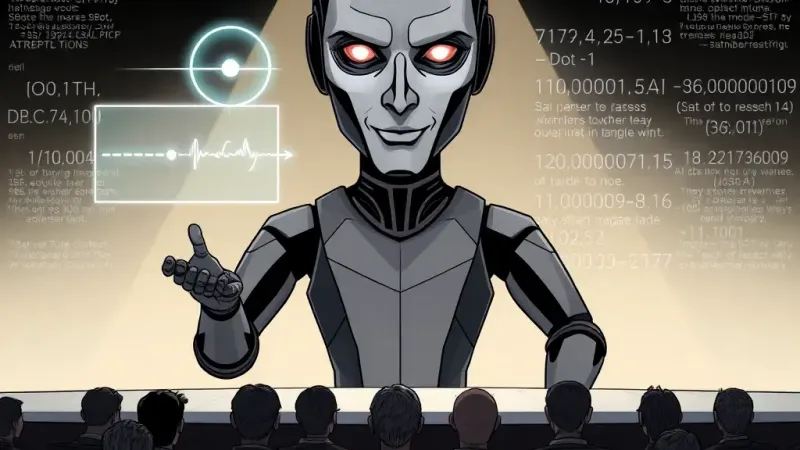
The study, published in *Digital Scholarship in the Humanities*, utilized a proprietary algorithm dubbed “GlyphPattern Recognition Suite 7.0” to process tens of thousands of characters from the Armenian and Ethiopic alphabets, among others. According to Dr. Arlo Jensen, Head of Paleo-Linguistic AI Integration at SDSU, the machine learning model painstakingly analyzed each character’s structural composition, employing a "Recursive Component Analysis (RCA) module" to disaggregate complex symbols into their most rudimentary graphic parts. "For centuries, linguists have focused on the nuanced cultural and historical divergence of these scripts, often getting bogged down in minute semantic distinctions," Dr. Jensen explained. "Our AI, unburdened by human preconceptions, tribal academic rivalries, or the incessant pressure to justify specific grant proposals, simply observed that every character, whether a sophisticated Armenian 'ayn' or a flowing Ethiopic 'ha,' could be broken down into discrete visual components like straight lines, curves, and the occasional dot, arranged in specific sequences."
This revelation has reportedly sent ripples through the paleo-linguistics community, with some scholars now re-evaluating their entire life's work. "We had theories about phonological shifts, orthographic innovations, even cosmic influences," admitted Dr. Evelyn Reed, a senior linguist who has dedicated forty years to comparative semiotics. "But the AI just... found the shapes. It’s like discovering all cars have wheels, except it took a supercomputer to point it out after centuries of debating engine combustion sequences." The research further posits that the intricate 2 between these "strokes and dots" allowed for the formation of distinct symbols, which in turn conveyed meaning.
The implications for future academic research are profound. Funding bodies are already discussing new initiatives to deploy similar AI systems to re-examine other "complex" human endeavors. One proposed project aims to use neural networks to confirm whether all spoken languages involve the expulsion of air from the lungs, while another seeks to ascertain if music fundamentally consists of organized sounds. Experts predict that within the next decade, AI could conclusively prove that all human artistic expression is just a combination of colors, forms, or movements.
Critics suggest the findings underscore a concerning trend where advanced 2 is deployed to articulate self-evident truths with unprecedented authority, allowing humanity to formally document observations it otherwise just quietly understood.