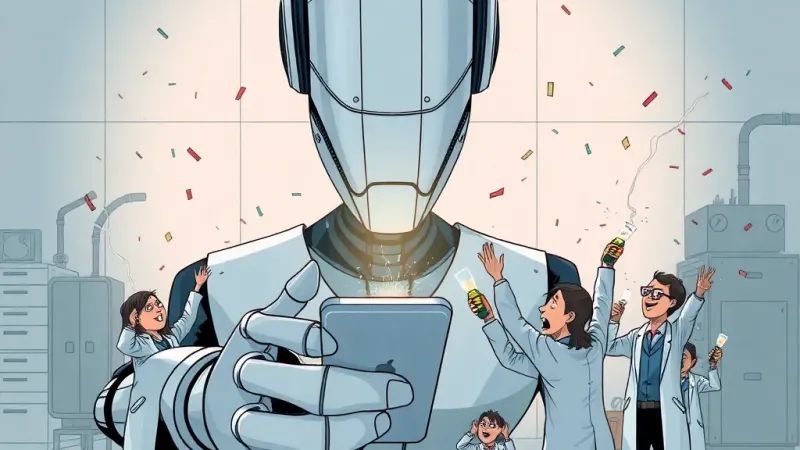
PALO ALTO, CA — A cutting-edge, physics-based AI model, developed by researchers at the Institute for Advanced Computational Materialistics, has identified a novel dielectric material capable of reducing refresh rates on popular social media platforms by a staggering 0.003%. The discovery, hailed as a monumental leap in the pursuit of marginal gains, is expected to enhance the user experience for billions of digital citizens who simply cannot wait an extra picosecond for their doomscrolling.
The AI, dubbed 'MaterialMancer 3000,' processed trillions of atomic configurations in mere seconds, sidestepping the 'tedious and emotionally draining' experimental phase typically associated with material science. Its primary finding, provisionally named Quantum-Optimized Dielectric for Ubiquitous Laziness (QODUL), promises to allow smartphone micro-capacitors to store and release electrical charges with such precision that users may, theoretically, detect a micro-fractional latency reduction while refreshing their feeds.
“For years, we’ve relied on intuition, trial-and-error, and occasionally, pure unadulterated luck,” stated Dr. Arlo Finnegan, head of Theoretical Material Applications and lead researcher for the project. “Now, the AI just… spits it out. It’s both exhilarating and frankly, a bit demoralizing. I dedicated my entire adult life to understanding electron excitation in complex perovskites, and this thing just learned it from a spreadsheet and decided the best application was making TikTok load marginally faster. The human element, it turns out, was mostly just slowing down the inevitable march towards increasingly efficient triviality.”
Industry insiders are already salivating at the prospect. "This isn't just about faster refreshes; it's about optimizing the entire human-digital interaction for maximum engagement and, by extension, maximum ad impressions," explained Brenda Sterling, CEO of 'InfiniteScroll Innovations,' a leading tech conglomerate. "Our Series 16 micro-capacitors, incorporating QODUL, will ensure that by 2026, the average user will spend 37 additional nanoseconds per day interacting with our platforms. That translates to billions in shareholder value from simply shaving off imperceptible wait times."
The researchers emphasize that while the initial application of QODUL is focused on social media, its underlying principles could theoretically be applied to other areas where incremental efficiency gains are valued over, say, solving climate change or curing diseases. The team plans next to train MaterialMancer 3000 on developing a material that can prevent slight screen glare in direct sunlight.
In related news, several prominent physicists have reportedly begun retraining as professional TikTok dancers, citing a desire to contribute to the 'next generation' of digital engagement in a more direct, human-driven way.