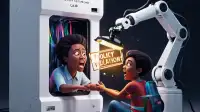

San Francisco, CA – A growing number of AI startups are revolutionizing their hiring practices by actively seeking candidates with minimal to no prior experience or specialized skills, sources confirmed Tuesday. This novel approach, championed as "unburdened cognitive bandwidth sourcing," posits that individuals unhampered by established methodologies are more receptive to AI-driven workflows and proprietary neural architecture frameworks.
The shift marks a significant departure from traditional resume-based recruitment, with HR departments reportedly scanning for indicators of "pre-existing knowledge liabilities." "Frankly, we've found that people who know things tend to cling to those things," explained Dr. Evelyn Chen, Chief Futurist at SynthMind Labs, during a recent industry panel on "Human Capital De-optimization." "Our ideal candidate isn't someone who can code in Python; it's someone whose mind is a pristine data lake, ready to be filled exclusively by our proprietary AI solutions. Think of it as pre-training a human model for maximum synthetic intelligence compatibility." She noted that SynthMind's internal metrics showed a 37% faster onboarding time for hires who "demonstrated zero legacy cognitive pathways," and a 12% lower incidence of "human-generated workflow friction."
This trend has been lauded by venture capital firms eager to streamline human capital costs and maximize "AI-synergy quotients." Recruiters are now advised to look for "blank slates" — individuals who can "adapt without the drag of competence," according to a recent white paper from the Future Workforce Institute titled "The Empty Vessel Advantage: Why Less Is More (for Us)." Interviews frequently include "AI-integration empathy drills" and "unlearning simulations," where candidates are tasked with forgetting basic concepts to prove their malleability. One popular exercise involves asking applicants to design a basic household object using only hand gestures, then immediately forgetting how they did it before a prompt from the "Cognitive Erosion AI."
Sources close to several Series B startups reveal that some companies are even offering "de-skilling bonuses" to new hires who can prove they've successfully abandoned previous professional proficiencies, often administered via a "Knowledge Dissolution Reimbursement Program." "We see past expertise as technical debt," stated Kyle 'K-Dub' Dubinsky, CEO of BrainDrain AI, from his bio-luminescent office pod. "Why pay for someone who already knows C++ when our AI can generate C++ 10,000 times faster? What we need is someone who can look at the generated code and say, 'Wow, that's code!' and then immediately forget what code is, making room for the next AI output. It's about maximizing 'human-AI subservience potential' for optimal operational efficiency." Dubinsky added that future plans include neural implants to accelerate the 'unlearning' process.
Industry analysts predict that within five years, the most sought-after employees will be those who can successfully replicate the functional output of a houseplant, but with an adjustable internal LED light.