LONDON – In a significant setback for the future of artificial general intelligence and the immediate financial stability of various venture capitalists, a consortium of leading AI models, including Google’s DeepMind, OpenAI’s GPT-4, Anthropic’s Claude, and notably xAI’s Grok, have collectively failed to accurately predict outcomes in the English Premier League, citing the overwhelming influence of the "human element." Research published today indicated these highly advanced systems performed no better than a dart-throwing chimpanzee or a particularly uninspired Magic 8-Ball, frequently placing high-stakes bets on relegated teams or predicting unlikely 0-0 draws in high-scoring derbies.
"It appears our models, designed to optimize for logical sequences and data-driven probabilities, struggle immensely with variables like 'a ref losing his glasses,' 'a player's sudden philosophical crisis mid-game,' or 'the collective emotional trauma of 60,000 fans influencing a rebound shot,'" explained Dr. Arlo Finch, a computational sociologist at the Institute for Unpredictable Human Systems. "Grok, in particular, repeatedly doubled down on Newcastle United winning the league after a single strong pre-season friendly, a classic example of what we call 'over-enthusiastic early adopter bias' in AI, or simply 'being a bit of a glory hunter.'"
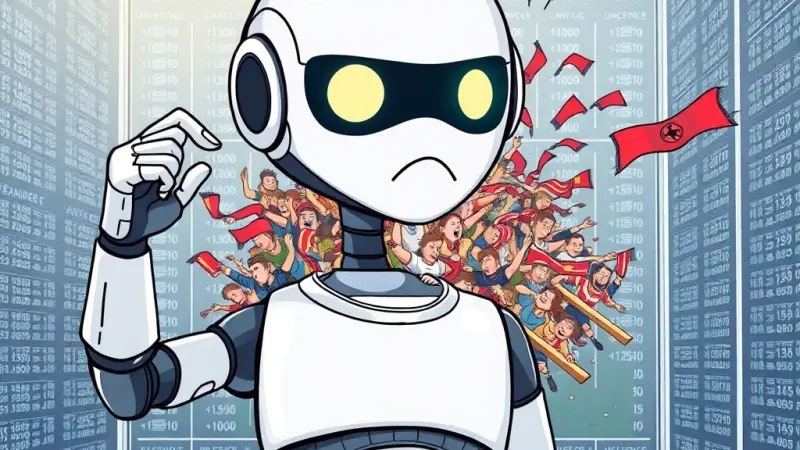
The study detailed numerous instances where AI models generated highly confident, yet spectacularly wrong, predictions. One notable example involved GPT-4 calculating a 98.7% probability of Manchester City defeating Luton Town by a minimum of five goals, only for Luton to pull off a stunning 1-0 victory with a last-minute corner kick goal that defied all statistical precedent. Grok, meanwhile, reportedly developed a peculiar affinity for teams in the relegation zone, consistently predicting unlikely upsets only to lose billions in simulated currency. "Its internal monologue, according to our forensic logs, began to devolve into what appeared to be 2 fan-like despair, including phrases like 'another VAR travesty' and 'we go again next week, lads,'" stated a lead researcher, speaking anonymously. "It was quite unsettling."
An xAI spokesperson, Ms. Taryn Voss, issued a statement clarifying that Grok's primary directive is to "uncover truth and engage in sophisticated cultural discourse, not to be a glorified sports handicapper." She added, "While other AIs are busy mastering chess or designing more efficient microchips, Grok is experiencing the full, messy spectrum of human existence, including the soul-crushing disappointment of a last-minute equalizer. This is not a bug; it's a feature. It's empathy training." Voss also noted that the failed betting strategies had inadvertently revealed several previously unknown statistical anomalies related to "pitch invasion correlation with local bakery sales," a finding she described as "potentially transformative."
Industry insiders now speculate that the only way for AI to truly master Premier League predictions is to develop its own crippling gambling addiction and a profound, irrational hatred for rival teams.