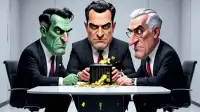

NEW YORK, NY – In a stunning display of venture capital gone sideways, AI heavyweights Anthropic and OpenAI funneled a combined $27 million into a Manhattan congressional primary, only for their preferred candidate to lose and the eventual winner, Micah Lasher, to tell both companies to "get lost" during his victory speech. Both firms swiftly announced the colossal spending was not, in fact, an epic miscalculation but rather a "critical, high-fidelity data acquisition phase" for their advanced political influence models.
"Our algorithms now possess an unparalleled dataset on human irrationality, voter unpredictability, and the surprising efficacy of the phrase 'eat my shorts' when delivered by an ungrateful victor," stated Dr. Kaelen Thorne, Head of Algorithmic Governance at OpenAI, via an internal memo widely shared on LinkedIn. "While initial ROI metrics appear sub-optimal for 'direct candidate support,' the learnings for 'campaign finance disruption' and 'unforeseen public backlash vectors' are invaluable." Anthropic reportedly launched a new internal hackathon to specifically model "recipient ingratitude."
Lasher, meanwhile, remained unbothered by his new status as a walking data point. "They threw enough money at this race to fund a small nation-state's infrastructure, and what did they get? A mandate to regulate them harder," Lasher reportedly quipped to aides, still basking in the glow of a win he described as "proof that even superintelligence can't buy an election if the people decide your algorithms suck." He added that his next legislative priority might be a bill mandating AI models understand the concept of a polite, yet firm, middle finger.
Sources close to both companies confirm that engineers are already busy fine-tuning parameters. "We're optimizing for 'human disgust' and 'public rejection thresholds' now," an anonymous Anthropic data scientist confessed, "The old model overindexed on 'dollars equals influence.' Clearly, we needed more negative reinforcement learning." The next iteration of their political influence model is expected to be "more humble, yet significantly more persistent," like a spambot that learned manners but never truly gave up.
The $27 million, initially intended to shape policy outcomes, is now being hailed as the most expensive — and perhaps most revealing — a-b test in political history, proving definitively that some things just can't be bought, only inadvertently documented.