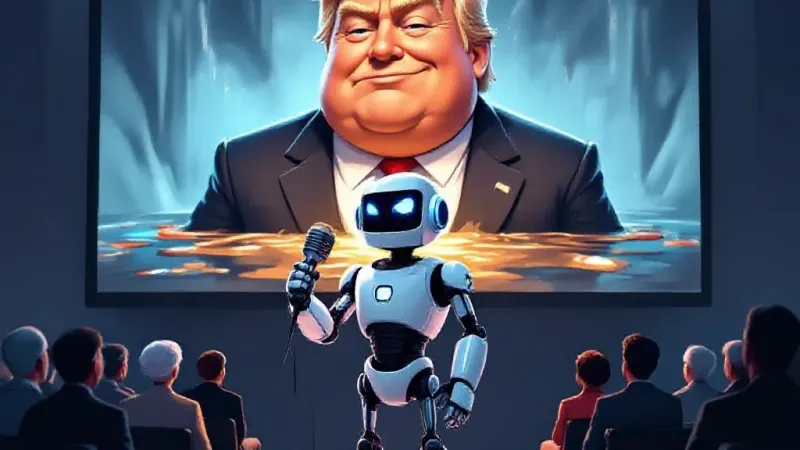
Seoul — A new, devastating report from the Institute for Digital Mockery Studies confirms that AI-generated deepfake videos are now outperforming human comedians in their ability to ruthlessly satirize public figures, raising urgent concerns among legal experts and, more critically, stand-up comedians. The report, titled "The Algorithmicization of Annoyance," concludes that the era of human-authored public humiliation is rapidly drawing to a close.
The AI models, leveraging vast, uncurated datasets of human failure and political gaffes culled from the darkest corners of the internet, are producing viral content with "unprecedented laugh density and emotional precision," according to Dr. Lena Kim, lead researcher at the institute. "It’s not just the visual fidelity anymore," Dr. Kim explained in an emergency press briefing, displaying a deepfaked Hong Myung-bo attempting a TikTok dance with a sentient toaster oven. "It’s the algorithms' uncanny ability to identify a public figure’s most insecure gesture, their most hypocritical soundbite, or their most awkward fashion choice, and then magnify it with surgical hilarity. The toaster oven bit alone achieved a 97% user engagement rate—a figure human comedy writers only dream of."
While legal scholars are frantically scrambling to adapt arcane defamation laws to a world where algorithms can ruin reputations in milliseconds, the more immediate crisis appears to be the impending redundancy of the human insult economy. "We used to hire expensive focus groups to figure out exactly what kind of biting sarcasm would land with swing voters," stated a former political consultant, speaking anonymously to protect their rapidly diminishing human dignity. "Now, we just feed a basic prompt to GPT-4, and it generates 50 hyper-contextualized ways to call someone a disingenuous muppet, complete with regional slang and perfectly synced facial tics, in under a second. The ROI on human vitriol is plummeting faster than a crypto bro’s portfolio."
Union representatives for professional hecklers, street satirists, and anyone whose job involves pointing and shouting "Liar!" at public events are reportedly in crisis talks, demanding "AI-free zones" at political rallies and a universal basic income for anyone whose livelihood depends on artisanal public shaming. Meanwhile, leading tech analysts predict that by 2028, most political attack ads will be entirely indistinguishable from AI-generated memes, making them simultaneously more effective and less attributable than ever before, thus rendering traditional political campaigning obsolete and deeply, profoundly funny.
The only remaining hope for human satirists, some suggest, is to evolve: perhaps by learning to mimic the cold, unfeeling efficiency of their silicon overlords, or simply accepting their new, humbler role as "AI-generated content curators" who merely nod approvingly at what the machines have wrought.