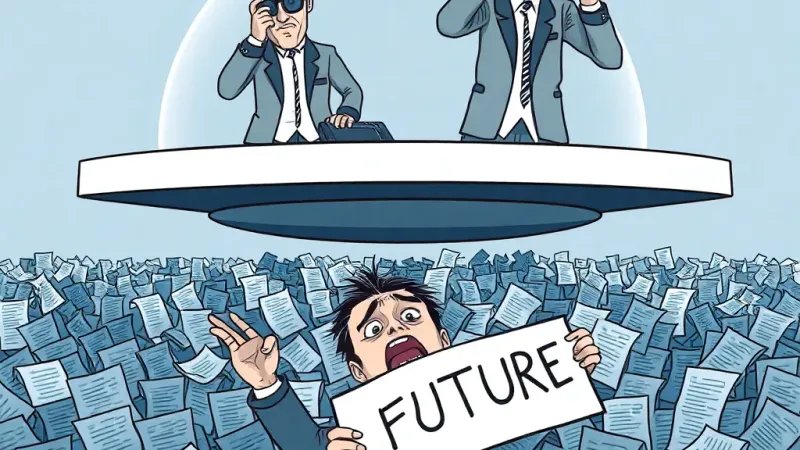
2, CA — A groundbreaking new report from Stanford University’s AI Index has revealed a startling chasm between the technologists spearheading the 2 revolution and the general public, with developers expressing confusion over widespread public anxiety regarding job displacement, healthcare automation, and economic instability. The report, titled “The Empathy Gap: Why Nobody Wants What We’re Selling,” notes that while AI creators are primarily focused on “disrupting paradigms” and “optimizing efficiencies,” the average citizen is apparently concerned about things like keeping their current employment and accessing affordable medical care without a robot overlord approving their deductible.
“We simply don’t understand it,” stated Dr. Kaelen Thorne, lead researcher for the AI Index and CEO of 'SynergyNet AI,' a company recently valued at $50 billion for its advanced algorithms that can predict which human roles will become redundant next. “We present them with a future of hyper-optimized services, predictive analytics for every facet of life, and the elimination of tedious human labor, and instead of cheers, we hear… ‘What about my mortgage?’ It’s quite perplexing. We thought they’d be excited to focus on their passions once AI handles all the boring stuff, like, you know, earning a living.” Dr. Thorne elaborated that initial projections for public enthusiasm were based on focus groups comprised exclusively of venture capitalists and early-stage startup founders, whose concerns about their future income streams were predictably minimal.
The report highlights a particular data point where 87% of AI developers believe the public “just needs to be educated” on the benefits of AI, while 92% of the public believes AI developers “live in a different dimension” where basic human needs are solved by algorithms that haven’t been invented yet. One particularly striking anecdote cited in the study involved an AI ethicist asking a group of displaced factory workers if they were excited about the "democratization of creative tools," to which one worker reportedly replied, "I'm excited about democratizing my grocery bill." The researchers found this response "anomalous" and suggested it might indicate a lack of "AI-ready mindset" among certain demographics.
Industry leaders interviewed for the study repeatedly emphasized that any perceived disconnect was merely a “communication challenge,” not a fundamental disagreement on the trajectory of society. “It’s about framing,” explained Ms. Blythe Sterling, Chief Optimism Officer at OmniMind Corp., a firm specializing in AI-powered emotional support chatbots that frequently advise users to “trust the process” when discussing job loss. “We just need to articulate the vision better. Perhaps through a series of engaging TikToks featuring cute AI avatars explaining how replacing human workers is actually a profound act of liberation. We're thinking a short, upbeat dance number explaining the metaverse of job opportunities. It's not that people are worried; it's that they haven't been adequately *excited* about what's coming.”
The Stanford team concluded its report by recommending increased funding for AI public relations campaigns, suggesting that if enough positive messaging is deployed, the public will eventually come to appreciate the elegant efficiency of their impending economic irrelevance.