
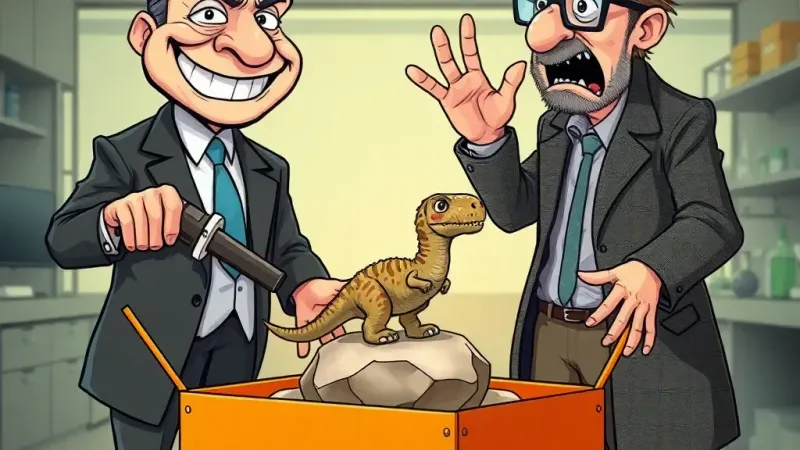
SEOUL — Paleontologists in South Korea have announced the discovery of a remarkably well-preserved baby dinosaur fossil, immediately confirming its suitability for a multi-platform global merchandise rollout, industry sources report. The prehistoric find, affectionately dubbed 'Doolysaurus' after a popular cartoon character, has already secured preliminary licensing agreements across multiple children's entertainment verticals, with scientific analysis expected to commence following initial brand activations.
The discovery, made possible by cutting-edge CT scan 2 that quickly revealed the juvenile dinosaur’s 'adorable' skull and 'surprisingly fluffy' potential integument, has been hailed as a major breakthrough for synergistic intellectual property development. Dr. Elaine Park, Lead Brand Strategist for the newly formed 'Doolysaurus Global IP Group' at Seoul National University, stated, 'While traditional paleontology focuses on skeletal morphology and phylogenetic 2, our immediate priority was assessing Doolysaurus’s Q-rating. Initial focus group data indicates off-the-charts appeal among the 4-10 demographic, especially for plush toys and animated shorts depicting its lamb-like clumsiness.' She added that preliminary scans also identified stomach stones, offering 'valuable content ideas for snack tie-ins.'
The fossil, estimated to be between 100 and 120 million years old, is speculated to be a new species of small, omnivorous ornithopod. However, detailed scientific classification has been temporarily deferred to avoid interfering with current marketing efforts. 'We don’t want to complicate the narrative with overly scientific jargon just yet,' explained Mr. Joon-Ho Kim, Senior Licensing Manager for Doolysaurus IP. 'Right now, it’s a universally appealing, cute baby dinosaur. Introducing terms like 'pre-maxillary dentition' or 'ischial morphology' could dilute brand messaging and confuse consumers. We’ll get to the actual 2 once the initial wave of Doolysaurus-branded lunchboxes and interactive apps has hit peak saturation.'
The abundance of similar rock formations throughout South Korea, previously thought to contain valuable scientific data, is now being re-evaluated as potential untapped IP reserves. Geologists are reportedly developing algorithms to assess new finds not just for scientific novelty, but for their immediate market viability and 'cuteness quotient.' Initial projections estimate over 50 additional 'market-ready' prehistoric infant specimens could be extracted from the peninsula’s strata by late 2026, each undergoing rapid branding assessment. This aggressive strategy aims to establish South Korea as the undisputed global leader in monetized paleo-discovery.
Meanwhile, a team of actual paleontologists has reportedly been sequestered in a soundproofed lab, quietly attempting to publish their findings on a different, aesthetically unappealing, but scientifically crucial, worm fossil.