
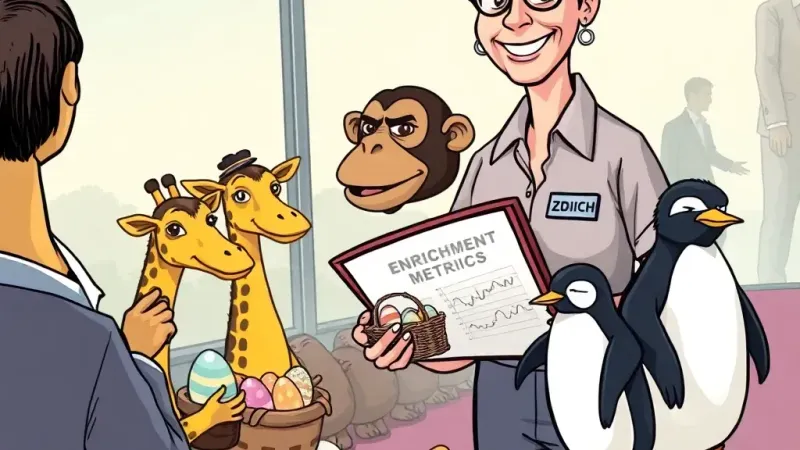
SANTIAGO – In a move lauded by animal behaviorists and criticized by bewildered parents, the Santiago Zoological Gardens has announced its annual Easter egg hunt will exclusively feature treats for its animal inhabitants, asserting that non-human participants offer a superior and more appreciative engagement experience than local children.
"After extensive data analysis, it became undeniably clear that our capybara population provided a significantly higher return on emotional fulfillment metrics than the average 6-year-old human," explained Dr. Elara Vance, Chief Behavioral Optimizing Officer at the zoo. "While children frequently exhibited suboptimal behaviors such as competitive hoarding, overt disappointment over prize allocation, or simply losing interest, our jaguars, for instance, demonstrated exemplary focus and immediate, measurable gratification in consuming their specially formulated, salmon-flavored eggs."
The zoo’s decision comes after years of struggling with what Dr. Vance termed "unpredictable human youth variables." Internal reports cited instances of public meltdowns, unhygienic consumption of dropped candy, and the perennial challenge of explaining why a plush bunny isn't quite the same as an actual, living rabbit. Conversely, the animals’ participation was described as "uniformly positive and remarkably on-brand with natural foraging instincts."
Local parents expressed a range of emotions, from resigned acceptance to thinly veiled outrage. "So, my kid, who actually understands what Easter is, gets nothing, but a sloth gets a papaya-filled egg?" questioned Lorena Morales, a mother of two, standing outside the zoo gates. "Is this what peak animal welfare looks like? Making humans feel like second-class citizens to a tapir?"
Zoo management clarified that the animals' eggs are meticulously designed by a team of veterinary nutritionists to meet precise dietary requirements, often containing nutrient-dense insect paste or fortified fruit purees. "These aren't just sugary treats," said Dr. Vance, gesturing to a diagram illustrating a three-tiered enrichment strategy for a critically endangered Andean bear. "This is critical behavioral 2 in action. Frankly, the children's event was becoming an administrative nightmare, and the ecological impact of plastic eggs was problematic. Our animals, however, are a much cleaner, more grateful, and frankly, less litigious demographic."
Organizers are reportedly exploring similar initiatives for other major holidays, including a Christmas present unwrapping event exclusively for the park's more dextrous primates.
Hambry is a satire publication. All articles are works of fiction.