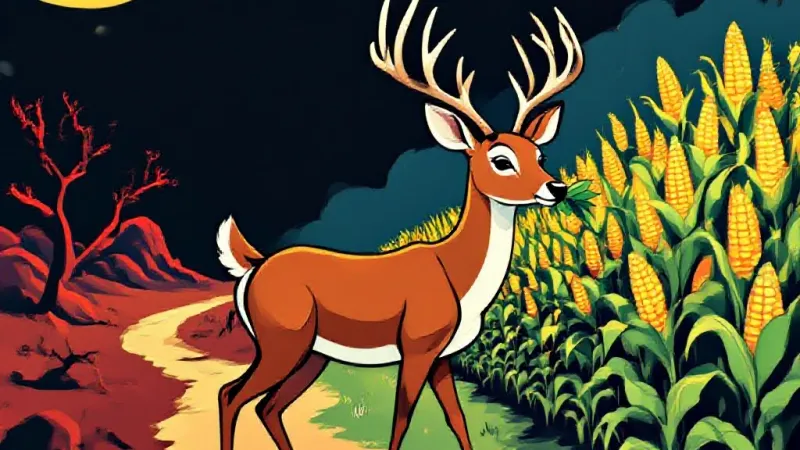
SALT LAKE CITY — In a groundbreaking report poised to redefine animal husbandry and basic zoology, researchers at the Utah Institute for Redundant Zoological Discoveries have concluded that mule deer, when faced with a choice, tend to migrate along routes that increase their chances of staying alive and decrease their likelihood of acute hunger. The study, published in the esteemed *Journal of Self-Preservation Metrics*, describes these preferred pathways as "invisible energy landscapes," a complex network of factors that, it turns out, includes avoiding ravines and finding leafy green things to chew on.
"This truly redefines our understanding of cervid decision-making at a granular, neuro-evolutionary level," stated Dr. Alistair Finch, lead researcher and co-author of the seminal work, speaking from a heavily secured, climate-controlled biodome. "For millennia, we've simplistically assumed these creatures were merely wandering aimlessly, propelled by some ancient, unknowable 'instinct.' Our cutting-edge GPS tracking and predictive modeling — leveraging AI-powered 'survival metrics' and 'resource optimization algorithms' — now confirm a sophisticated, almost *calculated* avoidance of sharp rocks, barren fields, and areas teeming with apex predators. They're not just moving; they're *pathing*." Dr. Finch noted with visible awe that the deer consistently chose paths that offered a higher probability of calorie intake and a lower probability of being ripped apart by a mountain lion.
The researchers painstakingly mapped what they refer to as "optimal caloric expenditure corridors" and "predator-disengagement superhighways," revealing that deer, to the team's apparent astonishment, tend to utilize them. "It's not just about the scenic route anymore; it's about 'energetic efficiency' and 'biomass retention,'" Dr. Finch elaborated during a press conference held within a meticulously cleared patch of artificial grass, complete with a laser-pointer demonstration. "This isn't just instinct; this is a complex interplay of genetic programming and the overwhelming urge to not be lunch. We also observed that deer tend to drink water when thirsty and seek shelter in bad weather," Dr. Finch added, already preparing a grant proposal for "Atmospheric Moisture Ingestion Landscapes" and "Adverse Climactic Shelter Preferences."
When pressed about the practical implications of such a monumental discovery, Dr. Finch explained that the findings could lead to "revolutionary approaches" in wildlife management. "We can now confidently advise conservation efforts to consider factors like 'food availability' and 'not being eaten' when designing habitats," he said, gesturing expansively at a PowerPoint slide depicting a digitally rendered deer successfully consuming a leaf. "The potential for human application, from urban planning to optimizing employee break times, is truly staggering. Who knew such deep wisdom resided in the humble cervid?"
The study's next phase will reportedly investigate whether bears demonstrate a similar inclination towards avoiding bee stings, locating picnic baskets, and performing what researchers are tentatively calling "optimal hibernation sequence initiation."