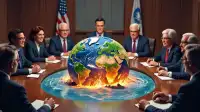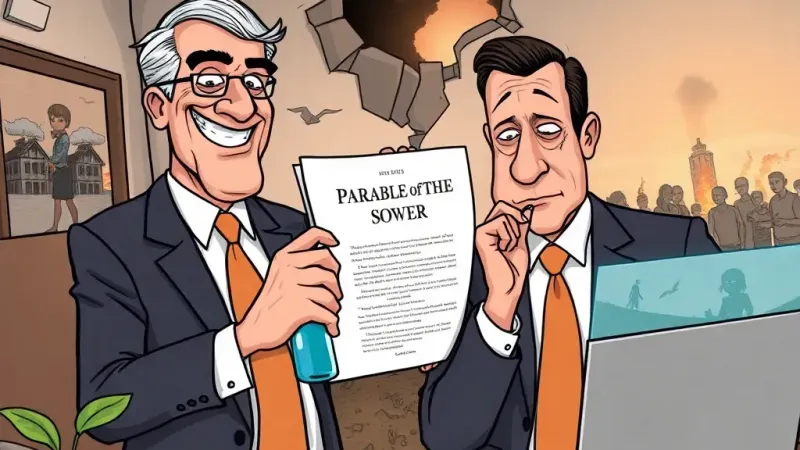
2 studio Warner Bros. has officially announced a highly anticipated film adaptation of Octavia E. Butler's prescient 1993 novel, "Parable of the Sower," while simultaneously assuring anxious audiences that the story's chilling depiction of a crumbling American society—ravaged by unchecked climate change, economic inequality, and rising fundamentalism—is "purely speculative fiction." The studio emphasized that the narrative bears no resemblance to contemporary global conditions, and any perceived parallels are purely coincidental. Melina Matsoukas is slated to direct the feature, which will reportedly undergo extensive "futurization" to prevent any accidental alignment with current headlines.
"We understand that some might find the novel's core themes—resource scarcity, privatized utilities, increasing ethno-nationalism, and communities forming defensive enclaves against a chaotic exterior—to be uncomfortably resonant with today's evolving global landscape," stated Warner Bros. Head of Future Narratives, Evelyn Holloway, in a pre-recorded statement released via secured corporate metaverse channel. "However, our creative team is entirely committed to ensuring this remains a work of profound, *imagined* fiction. We’re setting it well into the late 2040s, possibly even 2050, precisely to avoid any awkward real-world comparisons or implying that the foundational elements of American society are, in fact, already fraying under the compounding pressures of late-stage capitalism and ecological collapse. That would be, frankly, irresponsible from a storytelling perspective."
Industry analysts largely lauded the studio's "courage" in tackling such "challenging hypothetical concepts," praising the move as a timely exploration of "what-if" scenarios. Dr. Julian Vance, a tenured cultural futurist at the esteemed Center for Applied Dystopian Studies (CADS), remarked in an exclusive AI-generated interview, "It's genuinely fascinating how Butler, almost three decades ago, could so accurately predict the theoretical trajectory of a society that aggressively ignores climate 2, prioritizes corporate power over civic governance, and normalizes extreme wealth disparity. The fact that a major 2 studio is now investing nine-figure sums into dramatizing these *hypothetical* outcomes proves they are finally ready to engage with complex, academic 'what-if' scenarios. It’s certainly not an admission that they just spent thirty years profiting directly from the very systems that are now manifesting Butler’s vision, creating a lucrative market for these 'foreboding' adaptations."
Sources close to the production indicated that the film's global marketing campaign, budgeted at an estimated $120 million, will heavily emphasize its status as a work of "pure, unadulterated escapism." Early mock-ups for theatrical posters reportedly feature evocative taglines such as "The Future: It Couldn't Possibly Happen Here," and "Thank God This Isn't Real Life (Yet!)." A planned series of immersive 'survival-lite' virtual reality experiences will also launch alongside the film, allowing consumers to briefly simulate resource foraging and community defense before returning to their air-conditioned homes, stable Wi-Fi, and streaming subscriptions. The studio confirmed it is also exploring partnerships with major defense contractors and private security firms for 'secure perimeter' brand tie-ins and potential on-set technical consultation for realistic-looking, yet purely fictional, fortified compounds.
The studio anticipates the film will serve as a powerful, non-confrontational reminder of how bad things *could* hypothetically get, provided viewers don't accidentally glance out their windows at any point during the viewing experience.