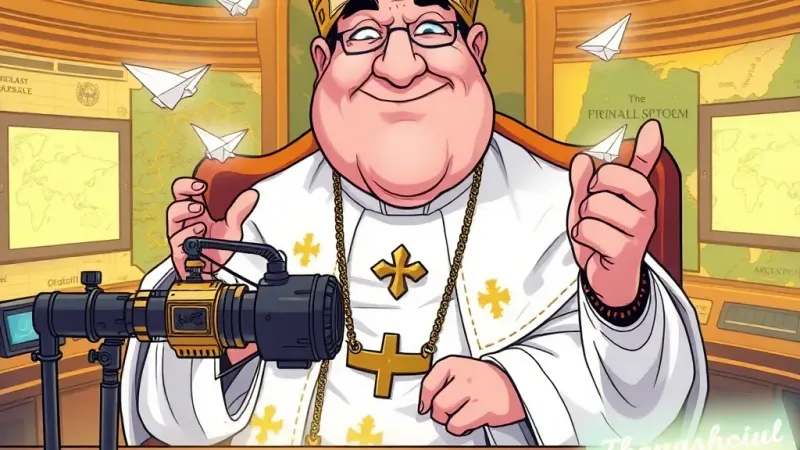
The Vatican announced today a groundbreaking new foreign policy initiative, officially codifying "thoughts and prayers" as a primary diplomatic tool aimed at global conflict resolution. The doctrine, unveiled by Pope Leo XV, marks a significant shift from previous, less formalized spiritual intercessions, elevating them to a central pillar of the Holy See's engagement with international hostilities.
During a solemn prayer vigil, His Holiness declared, "Enough of war!" a statement quickly translated into 147 languages and disseminated via official papal TikTok accounts. Vatican Secretary of State, Cardinal Pietro Silenzio, elaborated on the new approach, explaining, "While previous popes have certainly prayed for peace, this new doctrine provides a robust, institutional framework. We’re moving beyond ad-hoc supplications to a structured, scalable model of spiritual engagement." He noted that the Vatican’s immense historical and cultural assets, including its vast art collections and meticulously maintained investment portfolios, would remain “strategically deployed elsewhere” to support its broader mission.
Under the new policy, each major global conflict will receive a minimum of three specific papal mentions per month, alongside dedicated rosary-based petitions and an allocated 0.0003% of the Vatican’s annual spiritual efficacy budget. "This isn't just passive wishing," Silenzio emphasized. "This is active, high-level non-intervention. We are harnessing centuries of prayer data to pinpoint optimal times for spiritual interdiction, ensuring maximum celestial impact with minimal terrestrial footprint. Think of it as a low-carbon, high-impact diplomatic posture, perfectly aligned with our commitment to environmental sustainability and fiscal prudence." He added that a new department, the Pontifical Bureau for Theosophical Conflict Avoidance, would oversee these efforts, utilizing proprietary algorithms to predict the spiritual 'sweet spot' for intervention without actual involvement.
Political analysts were quick to praise the Church's innovative strategy. "It's bold, it's cost-effective, and crucially, it avoids any awkward entanglement in the messy specifics of who's actually fighting whom," commented Dr. Evelyn Hayes, a geopolitical strategist at the Institute for Unactionable Policy. "For too long, the international community has focused on things like sanctions, negotiations, or even peacekeeping forces. The Vatican has wisely pivoted to a strategy that is equally effective at not stopping conflicts, but far more morally defensible. It's about providing comfort, not solutions." Dr. Hayes highlighted the doctrine's potential to generate positive media coverage without incurring any significant operational costs or political liabilities.
The initiative has reportedly garnered support from various international bodies, with several national leaders confirming receipt of the papal decree and assuring the Vatican that its concerns have been "duly noted and filed." One senior diplomat, speaking anonymously, remarked, "It’s a lovely gesture. Very poetic. Gives us all something to nod solemnly about before we get back to selling arms." The Vatican also plans to release quarterly reports detailing the number of conflicts 'thought about' and 'prayed over,' along with a projected spiritual peace index, allowing for clear metrics of the doctrine's non-impact. A special line of commemorative 'Peace Through Prayer' rosaries, certified as ethically sourced from artisanal workshops, is also expected to launch next quarter.
Critics suggest the doctrine's only tangible impact might be a slight increase in prayer bead sales, while others lauded it as "a significant step towards doing absolutely nothing in the most consecrated way possible."