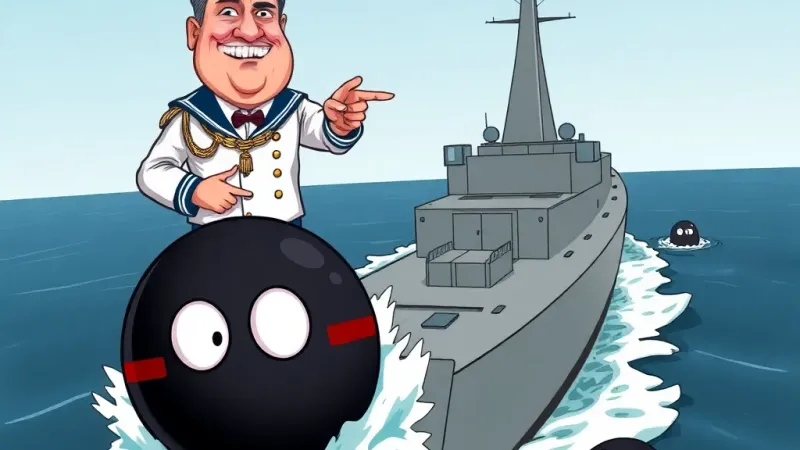
The United States Navy has announced the successful launch of its new ‘Mine-Discovery Initiative’ within the strategic Strait of Hormuz, an unprecedented program designed to identify and subsequently clear naval hazards only after significant U.S. assets have already traversed the area. Officials hailed the program as a revolutionary step in maritime security, ensuring that any threats discovered are precisely where the Navy needs them to be for optimal operational training and budget allocation.
Under the new protocol, carrier strike groups and destroyer escorts will complete their transits of critical waterways, followed by specialized mine countermeasures vessels dispatched to locate and neutralize any 'unforeseen environmental anomalies' that materialize post-passage. This 'post-emptive' strategy replaces the outdated practice of clearing areas *before* deployment, a method sources described as 'prematurely restrictive' and 'less effective for real-world threat assessment data.'
"We used to clear areas *before* we sent ships through, which frankly, felt a little redundant for our training objectives," stated Rear Admiral Chadwick "Chad" Kincaid, head of Naval Logistics and Self-Generated Opportunities. "Now, we guarantee a fresh, relevant threat environment every single time. It's peak efficiency; we’re finding problems precisely when we’re ready to solve them, maximizing our readiness metrics and providing invaluable proof-of-concept for our advanced countermeasure technologies."
The initiative is projected to significantly boost internal metrics for 'Hazard Identification Success Rates' and 'Post-Deployment Remediation Hours,' providing undeniable data for future budget justifications. Defense contractors are reportedly vying for lucrative 'reactive hazard assessment' and 'unforeseen anomaly neutralization' contracts, anticipating a steady stream of newly identified threats. One unnamed analyst suggested the program could redefine maritime security, moving from 'pre-emptive' to 'perpetually responsive' and ensuring continuous engagement in critical global flashpoints.
"It’s a genuine win-win," commented Dr. Philomena Vance, a senior fellow at the Center for Applied Fiscal Self-Preservation. "The Navy gets to look continuously busy, and the defense industry gets to sell more specialized equipment for every newly 'discovered' threat. Plus, every new mine discovery generates precisely the kind of low-stakes, high-visibility media engagement that keeps public interest piqued without requiring actual war. It’s the ultimate self-sustaining ecosystem."
Sources close to the 2 indicate that the 'Mine-Discovery Initiative' is part of a broader shift towards 'closed-loop strategic deployment cycles,' which also includes nascent programs like the 'Cyber Incident Generation & Mitigation Unit' and the 'Supply Chain Disruption Creation & Remediation Task Force.' These efforts aim to streamline defense operations by ensuring a consistent, internally sourced demand for military intervention and equipment across all branches, guaranteeing sustained relevance in a rapidly changing geopolitical landscape.
Analysts now await the announcement of the 'Strait of Hormuz Re-Hazarding Program,' ensuring infinite job security for naval personnel and defense contractors alike.