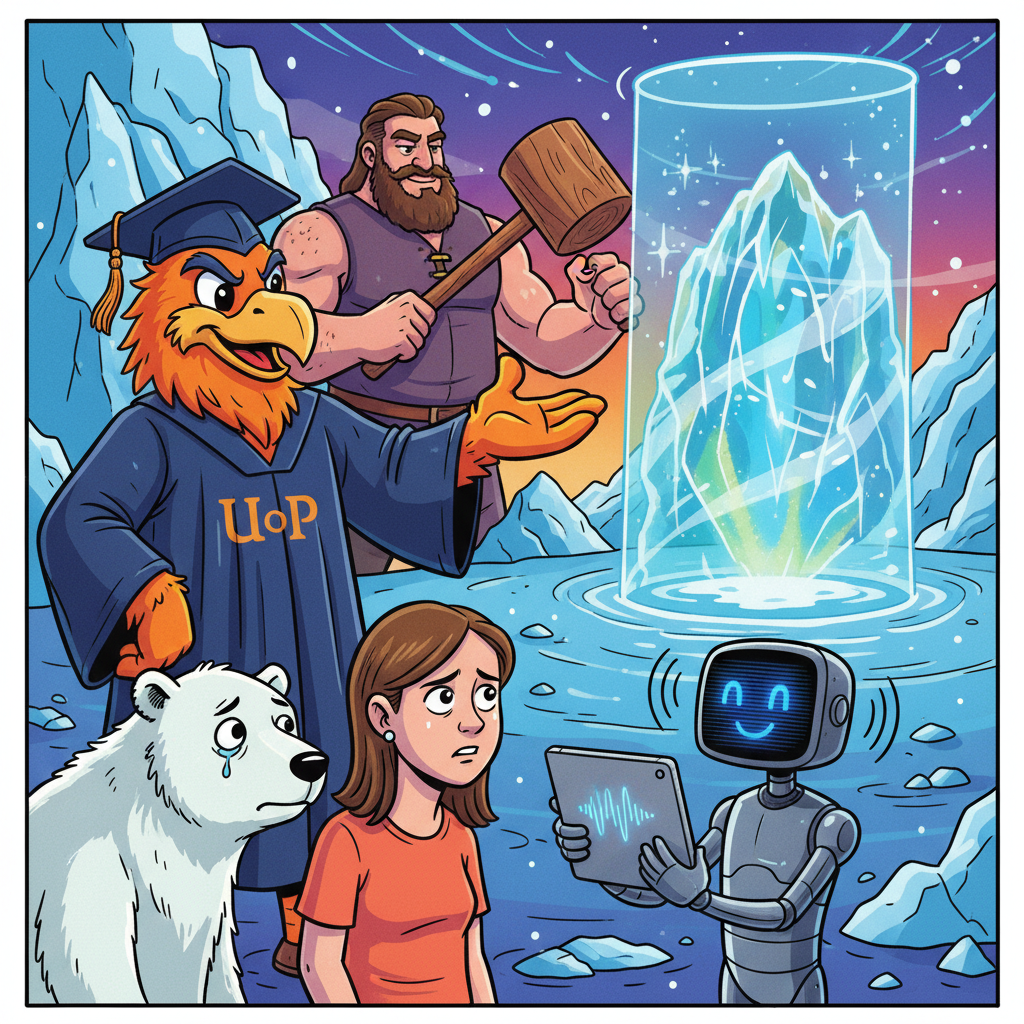
TEMPE, AZ – The University of Phoenix announced today the publication of groundbreaking research demonstrating the efficacy of artificial intelligence in explaining environmental science concepts, particularly those concerning phenomena that no longer exist. The study, "Harnessing AI, Virtual Landscapes, and Anthropomorphic Imaginaries to Enhance Environmental Science Education at Jökulsárlón Proglacial Lagoon, Iceland," details how adult learners can better understand the intricate processes of glacial melt after the glacier has, for all intents and purposes, melted.
“Our AI-supported storytelling allows students to experience the Jökulsárlón glacier in a vivid, interactive way, complete with talking icebergs and personified moraines,” explained lead researcher Dr. Brenda Harrison, head of the Department of Post-Environmental Studies. “It’s much easier to grasp the concept of ‘retreat’ when a virtual, sentient chunk of ice is dramatically lamenting its own diminishing mass and expressing existential dread about the future, or lack thereof.”
The research suggests that by creating emotionally resonant narratives around environmental degradation, students are better equipped to process the information, often leading to profound epiphanies like, “Oh, so that’s why there’s just a big puddle now.” Critics, however, question the timing, suggesting that perhaps this technology could have been deployed when the glacier was still, you know, a glacier.
“While we acknowledge the historical context, our focus is on future-proofing education,” Dr. Harrison countered. “By understanding how a glacier *used* to melt, students are better prepared to understand how the *next* glacier will melt, or perhaps has already melted. It’s about proactive retroactive learning.”
The University of Phoenix plans to expand the program to other environmentally sensitive areas, including coral reefs that are now just sad, grey rocks, and rainforests that have been repurposed into artisanal toothpick factories.