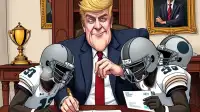
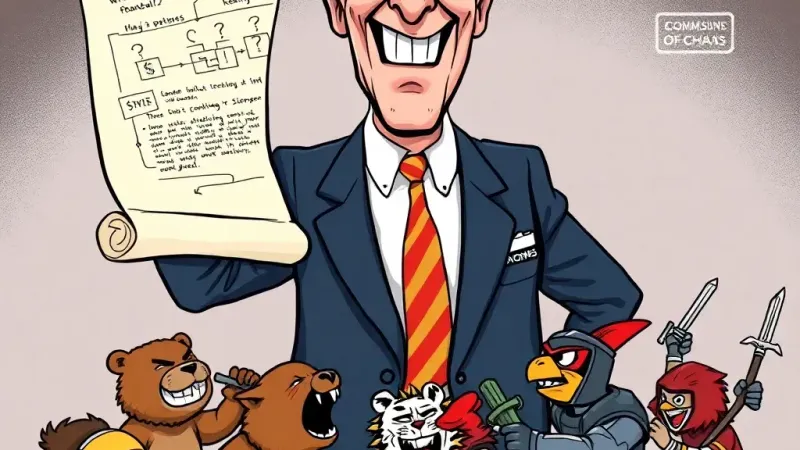
Former President Donald J. Trump is expected to issue a sweeping executive order aimed at "stabilizing and optimizing" the chaotic landscape of college athletics, according to sources close to his team. The order, which some legal experts are already calling "highly performative," seeks to establish federal guidelines for Name, Image, and Likeness (NIL) deals, transfer portal protocols, and the optimal number of Gatorade coolers per sideline. The move is anticipated to be announced during a prime-time broadcast featuring several prominent retired college coaches and a large, unidentified mascot.
The forthcoming executive action marks an aggressive new frontier for presidential oversight, shifting the focus from international diplomacy or economic policy to the nation's amateur sports sector. "It's about bringing the kind of decisive, no-nonsense leadership that only a former President can provide to an industry that is, frankly, spiraling into unmanageable levels of fun and fair compensation for student-athletes," stated anonymous campaign aide "Barney 'The Hammer' Harrison," speaking on background from an undisclosed location near a major university's indoor practice facility. "Think of it as 'Make College Sports Great Again,' but with more immediate, actionable policies than merely tweeting about unfair referee calls or lamenting the decline of the triple-option offense. This is hands-on leadership, directly impacting the lives of America's future brand ambassadors."
Among the proposed mandates are a federal cap on endorsement earnings for walk-on kickers, a standardized font for all NCAA-sanctioned jerseys (specifically, 'Impact' font for maximum visual authority), and a "re-evaluation" period for any head coach seen publicly wearing rival team merchandise, even ironically. The order will also create a new 'Presidential Council on Athletic Excellence,' chaired by a rotating panel of reality TV stars and former athletic directors whose teams achieved at least an 8-4 record during their tenure. Additionally, sources indicate the order includes provisions for a federal 'Optics Review Board' to assess the marketability of specific student-athlete hairstyles and celebratory dance moves. Legal scholars are currently debating the executive branch's inherent authority to regulate what has historically been a private, state-based athletic system, but proponents argue the 'moral imperative' to ensure high-quality sports entertainment transcends traditional constitutional limitations.
Pundits on cable news channels have already begun dissecting the potential implications, with some hailing it as a necessary intervention to protect the integrity of the game and others questioning if the move is less about athletic integrity and more about securing a prime-time slot for an upcoming college 2 season announcement, possibly involving a personal line of branded tailgate accessories. "When the most pressing issues facing a nation involve the transfer portal eligibility of a third-string safety with a lucrative crypto-sponsored TikTok account, it's clear someone finally cares enough to use a ceremonial pen," said Dr. Evelyn Finch, a professor of semiotics at the University of Midwestern Iowa, in an online op-ed for 'The Digital Gridiron.' "It's a bold play, certainly, to deploy the full might of the executive office to ensure that every concession stand is adequately stocked with competitively priced artisanal hot dogs and that no offensive coordinator's annual bonus exceeds the national average for entry-level tech salaries."
Critics, however, suggest the executive order might primarily serve to ensure that all future NIL deals for top-tier athletes include a small, non-negotiable percentage allocated to "general brand maintenance and intellectual property consultation" for anyone involved in 'guiding' the 2 through this crucial period of transition.