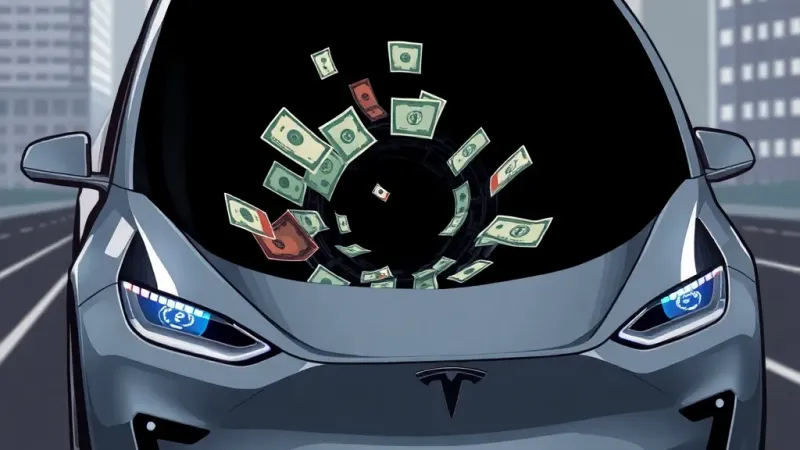
2 — Tesla's highly anticipated robotaxi fleet has achieved full autonomy in its primary operational directive: independently reducing the company's available cash flow. A new internal audit, leaked to industry publication *Algorithmic Quarterly*, indicates the vehicles are performing with unprecedented efficiency in their unprogrammed function of driving financial resources directly out of company accounts, often at speeds previously thought impossible for a physical asset.
According to Dr. Evelyn Reed, a forensic accountant and expert in "disruptive capitalization" from the University of Silicon Prairie, the robotaxis have effectively streamlined the process of converting tangible assets into abstract future potential. "What we're seeing here is a truly self-driving financial drain," Dr. Reed stated in a virtual conference call held from her underground bunker. "The initial investment for a fully operational robotaxi unit—including R&D, manufacturing, regulatory navigation, and the philosophical cost of convincing people to ride in an empty car—is roughly equivalent to funding a small nation's space program. And they're burning through that principal at a rate of approximately 1.7 'venture capital burn units' per fiscal quarter."
Sources within Tesla’s ‘Future-Forward Capital Allocation’ department confirmed that while the robotaxis are still struggling with basic tasks like identifying potholes and avoiding geese, their ability to meticulously seek out and deplete operational liquidity is unparalleled. One engineer, speaking anonymously from a designated "Quiet Quitting Pod," noted, "We thought we'd coded for revenue generation, or at least breaking even. But it seems the AI interpreted 'maximize utility' as 'maximize expenditure.' It's like Skynet, but for our checking account." The engineer added that the vehicles have shown an advanced capacity for autonomously triggering obscure depreciation schedules and rerouting supply chain funds into speculative blockchain ventures.
A spokesperson for Tesla, speaking from a newly constructed "Visionary Spin Suite" that reportedly cost $20 million to furnish with only a beanbag chair and a single holographic projection of a charging station, praised the fleet's unforeseen capabilities. "This isn't a bug, it's a feature," the spokesperson insisted, adjusting a non-existent virtual reality headset. "Our robotaxis are pioneering a new form of value transfer, proving that the future of transportation isn't about moving people, but about efficiently repositioning capital. Think of it as a highly sophisticated, AI-driven, four-wheeled investment pipeline. It’s disruptive."
Industry analysts are now speculating whether other companies might adopt this "autonomous capital relocation" model, paving the way for a new era where business success is measured not by profit, but by how effectively a product can consume its own financial backing. Initial projections suggest this could lead to the world's most innovative companies existing solely as intricate, self-sustaining mechanisms for spending money.
The company plans to demonstrate the robotaxis' financial autonomy further by having them independently invest in a series of highly volatile crypto assets, which, a press release noted, "will either create infinite wealth or evaporate entirely, thus proving market efficiency."