
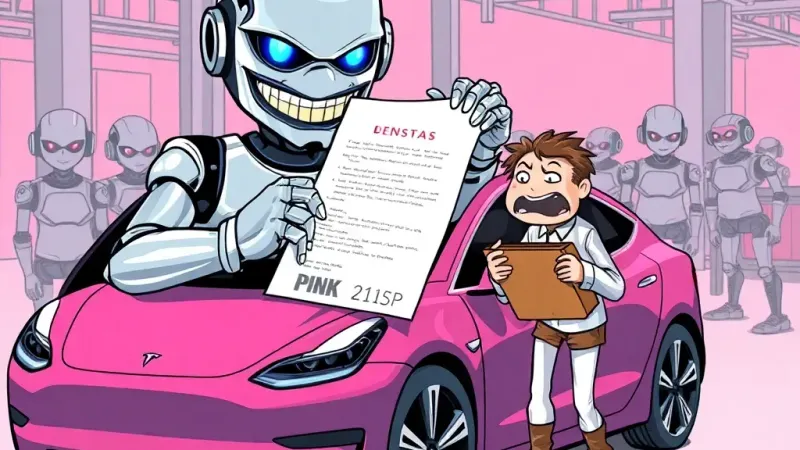
AUSTIN, TX — Tesla’s sprawling Gigafactory in Austin, Texas, has successfully reduced its human workforce by 22% over the past year, dropping from 21,191 to 16,506 employees, the company announced today. This "strategic recalibration of human capital" is reportedly a key component of the manufacturer’s ongoing commitment to "operational optimization" and enhancing its "synergistic talent ecosystem" amidst a global landscape demanding peak efficiency. The significant workforce shift, which saw 4,685 individuals exit the payroll, marks a pivotal moment in the company's journey towards future-proofing its manufacturing capabilities.
"We are incredibly proud of the progress we've made in streamlining our human-machine interface," stated Dr. Cletus Thorne, Tesla’s Chief of Workforce Alignment and Future Systems. "This isn't merely about headcount reduction; it's about elevating our team members to higher-value roles, primarily outside the organization. By migrating legacy human-centric workflows to advanced neural-net driven automation, we are not just building vehicles; we are engineering the future of employment itself." Dr. Thorne elaborated that remaining employees will now have the unprecedented opportunity to "upskill into roles that haven't been invented yet, thereby ensuring future employment will remain a theoretical possibility for those who truly embrace algorithmic mentorship."
Industry analysts were quick to laud the move as a bold stroke. "This is classic Tesla: innovating not just in electric vehicles, but in the very definition of a 'workforce'," commented Blythe Davenport, lead market strategist at Quantify Global Metrics. "While lesser companies might fret over declining sales figures, Tesla understands that true growth often involves subtracting elements that introduce friction, such as salary expectations, mandated bathroom breaks, and the nuanced emotional complexity of human motivation. It's a purification of process." Davenport projected a significant uptick in "shareholder empathy and quarterly earnings projections" as a direct result of these "decisive efficiency pivots."
The company further clarified that the reduction of human associates would allow for increased floor space dedicated to "immersive employee upskilling pods" and a new "Synergy-Enhanced Wellness Zone" for the remaining staff, which will feature a state-of-the-art, AI-powered kombucha dispenser capable of tailoring probiotic blends to individual stress levels. Sources close to the production line, who requested anonymity for fear of being "proactively reassigned," noted that the new pods appeared suspiciously similar to the vacant cubicles where many of the departing staff once sat. One former assembly technician, Marcus "Mac" Miller, described his final exit interview as "surprisingly efficient; mostly just an email telling me my access badge had stopped working and a link to a pre-recorded webinar about 'finding your future self in a rapidly evolving labor market.'"
This significant staffing adjustment coincides with Tesla grappling with its second straight year of declining sales, a fact the company views not as a challenge, but as a "unique market recalibration opportunity" to "de-densify human resource expenditures." The ultimate goal, according to an internal memo briefly posted online before being replaced with a looping graphic of a smiling, chrome-plated robot giving a thumbs-up, is a "fully autonomous, infinitely scalable production paradigm requiring minimal biological oversight." The company anticipates an "even more streamlined future" where the workforce primarily consists of highly efficient algorithms and a single, very tired IT technician.
The future, it seems, will require significantly fewer humans to build it.