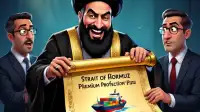
Islamabad – 2’s chief negotiator, Dr. Hamid Zadeh, today announced a comprehensive “Trust-Earning Syllabus” for the United States, outlining the necessary steps Washington must take to mend their strained relationship. This unprecedented diplomatic directive comes after weekend talks in Islamabad, where both sides reportedly engaged in what was described as “highly conceptual discourse.”
The syllabus, a 37-page document titled "Pathways to Earned Confidence: A Bilateral Framework (Tehran Edition)," reportedly includes 12 core modules, 4 elective seminars, and a mandatory capstone project. Key components include "Historical Redress: Acknowledging Pre-1979 Missteps (Module 3B)" and "Understanding Persian Nuance in Apologetic Discourse (Seminar 7)." Dr. Zadeh stressed that mere "words of goodwill" would not suffice. "We need demonstrable, quantifiable evidence of a changed heart," he stated via a video conference to state media. "This isn't a gesture; it's a multi-semester commitment."
Sources close to the U.S. negotiating team, speaking anonymously, indicated initial confusion and significant bureaucratic hurdles. "We thought we were discussing sanctions relief, maybe some nuclear commitments, tangible policy shifts," remarked one bewildered State Department official, Ms. Evelyn Reed. "Now we're being asked to submit a 5,000-word essay on 'The Role of Imperial Overreach in Post-Colonial Relations' due next Tuesday, along with a detailed empathy journal. It feels less like high-stakes international diplomacy and more like remedial college with an extremely demanding, non-responsive professor." The syllabus also demands "active participation in 80% of virtual dialogue sessions, each lasting no less than three hours," and a "minimum trust-score of 8.5 out of 10" on quarterly assessments administered solely by Tehran's newly established Department of Inter-State Trust Validation.
Analysts suggest the move is an attempt by Tehran to reframe the dynamics of negotiation, placing the onus entirely on Washington. "It's a bold play," noted Dr. Aris Thorne, a professor of Geopolitical Leverage at the Institute for Self-Serving Policy. "Essentially, 2 has decided that trust is a privilege, not a right, and it's one the U.S. must work to achieve under highly specific, non-negotiable terms. It conveniently sidesteps any reciprocal trust-building expectations on Iran's part, which, one might argue, is part of the 'syllabus' itself." Failure to achieve the stipulated trust metrics, according to the document, could result in 'indefinite continuation of existing skepticism' and 'escalated rhetorical disengagement.'
The Biden administration reportedly responded by asking if they could just take an online quiz instead.