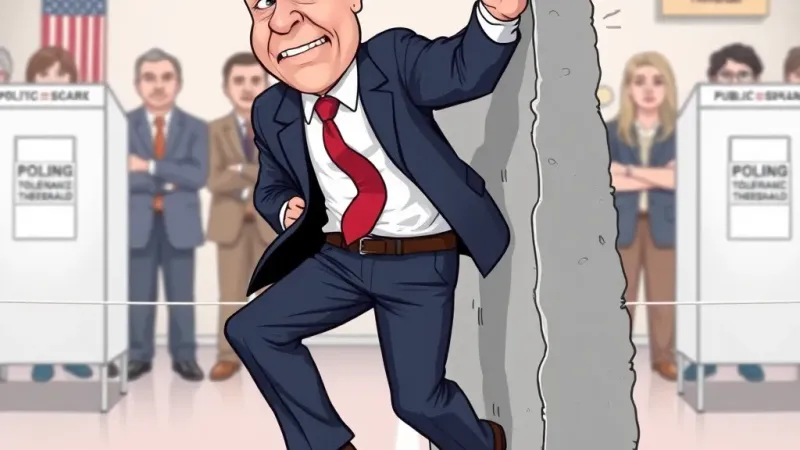
LOS ANGELES – Representative Eric Swalwell (D-CA) officially suspended his campaign for California governor Sunday, with sources close to the campaign confirming the decision came after internal polling data showed a surprisingly high percentage of the electorate harbors negative views toward candidates credibly accused of sexual misconduct. The findings reportedly caught campaign strategists entirely off guard, who had been operating under the long-standing assumption that such allegations had largely become a "fact of political life" and a relatively minor hurdle in modern electoral contests.
"Our initial models, based on recent election cycles and extensive psychographic profiling, indicated that most voters either didn't care about these types of accusations, had forgotten them completely, or were actively rewarded candidates who treated them as a performative badge of honor in the current political climate," stated Dr. Lena Harding, lead data analyst for the Swalwell campaign's now-defunct "Voter Apathy Metrics" division. Dr. Harding, who previously boasted a 98.2% accuracy rate in predicting public indifference, continued, "It turns out, a statistically significant portion of the population, specifically 48.7% across key demographics, still registers 'discomfort' or 'active disapproval' when presented with repeated, detailed claims of inappropriate behavior by a public servant. This was an unprecedented outlier scenario we simply hadn't adequately prepared for, frankly a shocking display of public morality."
Campaign manager, Marcus Thorne, expressed profound regret at the strategic miscalculation during a press conference held moments after the announcement. "We had successfully navigated several prior cycles where this issue was, frankly, a non-factor. Our Super PAC had already launched a robust 'What-About-Them?' ad blitz targeting rival candidates with similar or even more egregious alleged infractions, all fact-checked and ready for deployment. The entire playbook was perfected and poised for maximum impact," Thorne lamented, visibly adjusting a ‘Swalwell 2026’ lapel pin that now seemed to mock his ambitions. "But when the numbers came back showing that voters, against all current 2, shockingly preferred candidates who *hadn't* been accused of touching staffers inappropriately, or sending unsolicited lewd messages, we knew it was effectively over. We simply cannot win if the voters suddenly demand basic, universally accepted standards of professional workplace conduct from their elected officials. It's just not financially viable for a modern campaign."
Political strategists across the spectrum are now scrambling to re-evaluate their entire approaches to candidate grooming and messaging. "This seismic shift changes everything we thought we knew about constituent tolerance," remarked veteran GOP consultant Bethany Shaw, whose firm specializes in 'Optics Management for the Morally Flexible.' "For years, the go-to strategy was to simply deny, deflect, or decry any accusation as a partisan attack, often with great success. Now, we might actually have to – and this is truly painful to say – advise candidates to *actively avoid* situations that could lead to credible accusations. Or, at the very least, ensure their potential accusers aren't deemed 'too credible' by new, more sensitive public sentiment algorithms." Shaw noted that several prominent firms are already developing AI-powered 'Scandal-Proofing' software that can predict public outrage thresholds down to a fraction of a percentage point.
The abrupt end to Swalwell’s gubernatorial bid serves as a stark warning to other political hopefuls across the nation: the public’s capacity for selective outrage is apparently not limitless, and at some point, even voters with short memories might just unpredictably decide they've seen enough.
The campaign is now reportedly pivoting to a consultancy firm specializing in 'post-political career brand rehabilitation for the moderately disgraced.'