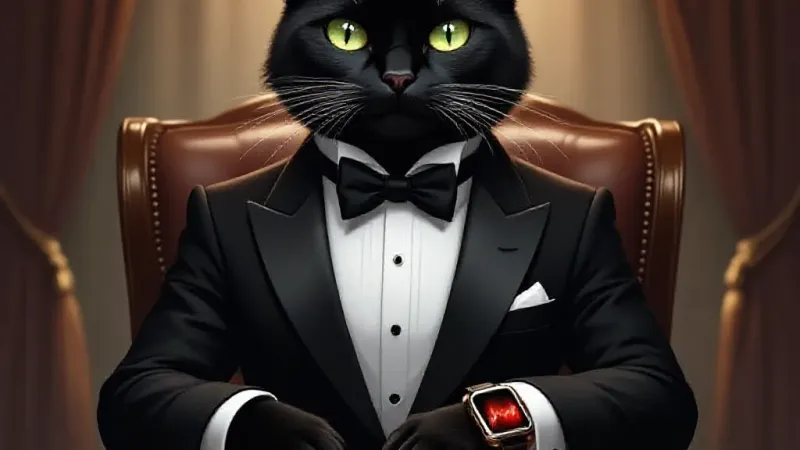
CAMBRIDGE, Mass.—A groundbreaking study published Thursday in the journal *Comparative Feline Endocrinology* has confirmed what millions of pet owners have long suspected: domestic cats share a direct, hormonal synchronization with their human caregivers, using this biological connection almost exclusively to maximize human suffering.
Researchers at the Harvard Institute for Applied Animal Malice spent three years monitoring the oxytocin, cortisol, and adrenaline levels of 450 cat owners alongside their feline companions. The data revealed a startling biological feedback loop in which the cat’s endocrine system acts as a high-precision sensor, detecting human vulnerability with military-grade efficiency.
"We initially hypothesized that this hormonal alignment was an evolutionary mechanism designed to foster mutual affection and pair-bonding," said lead researcher Dr. Aris Thorne. "What we actually discovered is that a cat's cortisol levels spike not when it is anxious, but when it detects that its human is attempting to achieve a state of relaxed tranquility or focus. It is less of a bond and more of a bio-chemical targeting system."
According to the study, when a human’s stress levels drop—such as during meditation, the start of a rare weekend off, or immediately after sitting down with a hot cup of tea—the cat’s endocrine system registers this calm as a biological threat to its dominance. Within ninety seconds of detected human peace, the cat’s brain releases a chemical cascade that prompts one of several instinctual responses, including knocking a heavy ceramic mug off a counter, sprinting through the apartment at 3:14 a.m., or yowling at a completely blank drywall corner.
Conversely, when a human experiences a sudden spike in panic—such as realizing they are late for a critical Zoom presentation—the cat’s brain secretes a burst of dopamine. The study noted that 89% of cats immediately sat directly on their owner's laptop keyboard within four seconds of the owner’s heart rate exceeding 110 beats per minute.
"It’s an incredible evolutionary adaptation," explained co-author Dr. Ellen Vance. "Dogs synchronized their hormones with humans to become cooperative hunting partners. Cats synchronized their hormones with humans to ensure that the moment you enter deep REM sleep, they can stand on your throat and stare at you with unblinking, predatory eyes."
Participants in the study reported that the research finally provided scientific validation for years of inexplicable pet behavior. Local resident Mark Miller described how his eight-year-old tabby, Sir Pounce, consistently used hormonal cues to ruin his life.
"Last month, I was finishing up my tax return after twelve hours of brutal spreadsheet work," Miller said. "My heart rate finally slowed down, my cortisol dropped, and I felt a sense of relief. That was the exact second Sir Pounce made eye contact with me, made a dry-heaving sound like a clogged garbage disposal, and deposited a moist hairball directly into the USB-C port of my open MacBook. Now I know it wasn't an accident. It was endo-chemical warfare."
The study also noted that the hormonal connection is entirely one-sided. While human owners experience massive surges of stress and blood pressure spikes during feline misbehavior, the cats themselves return to a state of absolute baseline tranquility the moment the damage is done. The feline heart rate drops to a soothing 60 beats per minute while watching a human clean liquid feces out of a sofa cushion with a toothbrush.
When asked if pet owners could do anything to disrupt this toxic hormonal loop, Dr. Thorne was pessimistic.
"Short of wearing a lead-lined biohazard suit to block your own pheromones, there is no escape," Thorne said. "Your cat knows when you are happy, it knows when you are rested, and it will use every organ in its body to ensure that state of grace does not survive the afternoon."