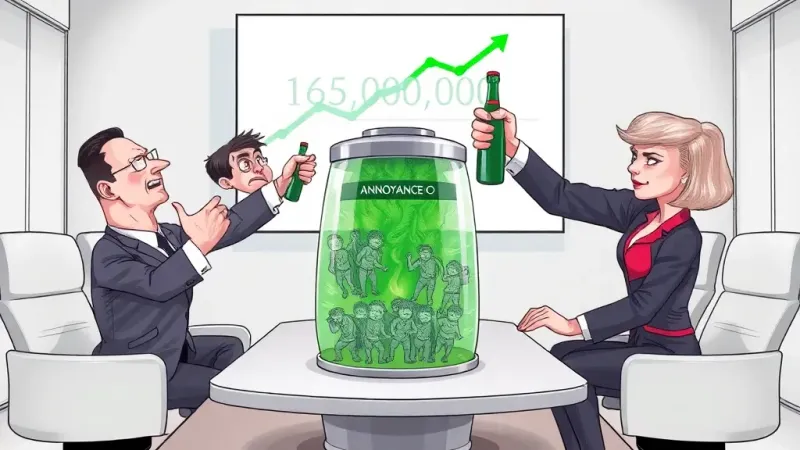
A new report from the Center for Consumer Exploitation (CCE) at the University of Southern Megacorp has revealed that U.S. households collectively contribute $165 billion annually to the "Annoyance 2," confirming what many suspected: companies are not accidentally frustrating you, they’re doing it on purpose.
The study, titled "The Deliberate Discomfort Dividend," details how businesses across sectors have shifted from mitigating customer pain points to strategically implementing "friction monetization" strategies. Researchers outlined key areas, including subscription cancellation labyrinths, forced ad viewing pre-content, mandatory app downloads for basic services, and "convenience fees" that achieve the opposite. "We initially set out to quantify the cost of inefficiency," stated Dr. Kendra Finch, lead researcher for the CCE. "What we found was a robust, intentional ecosystem where consumer frustration is no longer a byproduct but a measurable profit center. It's truly a testament to modern business ingenuity."
The report highlights the emerging role of "Chief Friction Officers" (CFOs) within corporations. "Our goal isn't just to sell a product; it's to embed ourselves so deeply into the customer's life cycle that even leaving us becomes prohibitively inconvenient," explained Bartholomew 'Bart' Grimsley, CFO at NexoCorp, a fictional conglomerate specializing in telecommunications and smart home devices. "From designing account settings that require exactly three calls and two forgotten passwords to changing auto-renew terms after the free trial, every micro-frustration is a meticulously crafted 'engagement opportunity.' We've found that customers are far more likely to simply absorb a $7.99 monthly fee than to spend 45 minutes on hold listening to elevator music." Grimsley cited NexoCorp's proprietary "Dissatisfaction-to-Retention Ratio (DRR)," which has reportedly improved by 17% quarter-over-quarter.
The CCE’s findings represent a significant paradigm shift for economists who previously categorized consumer annoyance as a market failure. Instead, it is now being reclassified as a highly successful market innovation. The study projects that the Annoyance 2 is poised for continued growth, with AI-driven optimization poised to personalize friction points for maximum financial yield. Future models could involve dynamically adjusting customer service wait times based on a user's perceived tolerance for bureaucratic purgatory, or tailoring in-app pop-ups to exploit specific psychological triggers for annoyance-induced purchases.
Industry analysts are already predicting a new wave of "Annoyance-as-a-Service" startups, promising businesses an outsourced solution to their customer's waning patience.