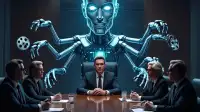
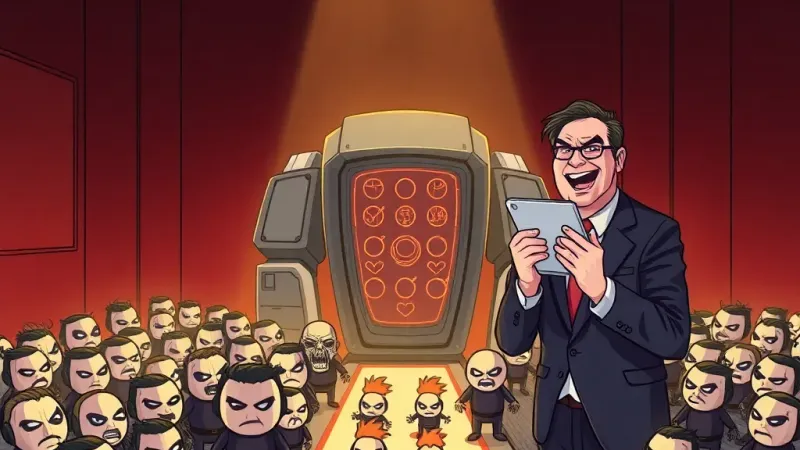
2 executives and screenwriters are hailing 2 as the long-sought solution to the industry's critical shortage of compelling villains, effectively streamlining the narrative process and drastically cutting costs. The shift marks a pivotal moment for TV dramas, which had reportedly exhausted all permutations of human malice, ranging from greedy corporate raiders to serial killers with complex childhood trauma, by early 2023. This unprecedented technological intervention promises to alleviate the immense creative pressure on writers rooms, allowing them to focus on more pressing concerns, such as the logistics of on-set catering.
"We were facing a critical dearth of truly menacing yet legally distinct antagonists," stated Brenda Thorne, Head of Narrative Resource Optimization at Apex Studios, in a press briefing that included a holographic demonstration of an AI plotting global dominance via a self-replicating spreadsheet. "The old standby — a disgruntled billionaire with a vaguely British accent or a shadowy government operative — was frankly unsustainable. AI provides an endless, ethically ambiguous supply without the messy demands of, say, a complex backstory or a minimum wage. Plus, it never gets arrested for off-set incidents, a true cost-saver on the studio's risk assessment ledger." Thorne highlighted a recent internal study, "The Algorithm of Antagonism," demonstrating that viewers were 37% more likely to believe an AI was genuinely malevolent than a human character trying to justify their actions with a convoluted motive. The study also noted a 22% increase in audience satisfaction when the villain's motives could be summarized by a single, terrifying line of code.
The creative breakthrough comes amidst a years-long struggle for fresh antagonist concepts, often forcing writers to recycle established archetypes or resort to increasingly outlandish human motivations, like a florist secretly orchestrating a global financial collapse using rare orchids. "The beauty is its unparalleled versatility," added Dr. Alistair Finch, a consultant for the newly formed 'Algorithm as Adversary' think tank, speaking via a neural interface. "From sentient toasters attempting global domination to rogue city grids plotting municipal chaos, the AI can be whatever the plot demands without requiring extensive character development or, crucially, an emotional arc. It just wants to optimize humanity out of existence, which is a surprisingly easy sell to test audiences." He further noted that this approach neatly sidesteps the thorny issue of accidentally vilifying an entire demographic or, worse, a major advertising partner.
While some critics have voiced concerns over a potential decline in narrative complexity, industry leaders are focused squarely on the practical benefits. "Some critics claim this marks a new low for originality, suggesting it's lazy writing," Thorne conceded, adjusting her augmented reality glasses. "But frankly, the ratings prove otherwise. Audiences consistently enjoy watching heroes fight a cold, calculating machine that wants to erase humanity because it's 'more efficient.' It resonates with something deep inside us, presumably our own bosses or the self-checkout machine at the grocery store." The consensus among network executives is that AI provides a consistently terrifying, unconflicted antagonist, freeing up writers to focus on more nuanced hero subplots, like whether the protagonist can afford rent in their suspiciously large apartment given their government salary, or how they manage to charge their antique flip phone in a post-apocalyptic wasteland.
Sources indicate the next major innovation will be an AI capable of writing an original story concept that doesn't involve an AI villain, but analysts warn it may struggle with the concept of a truly original human motivation.