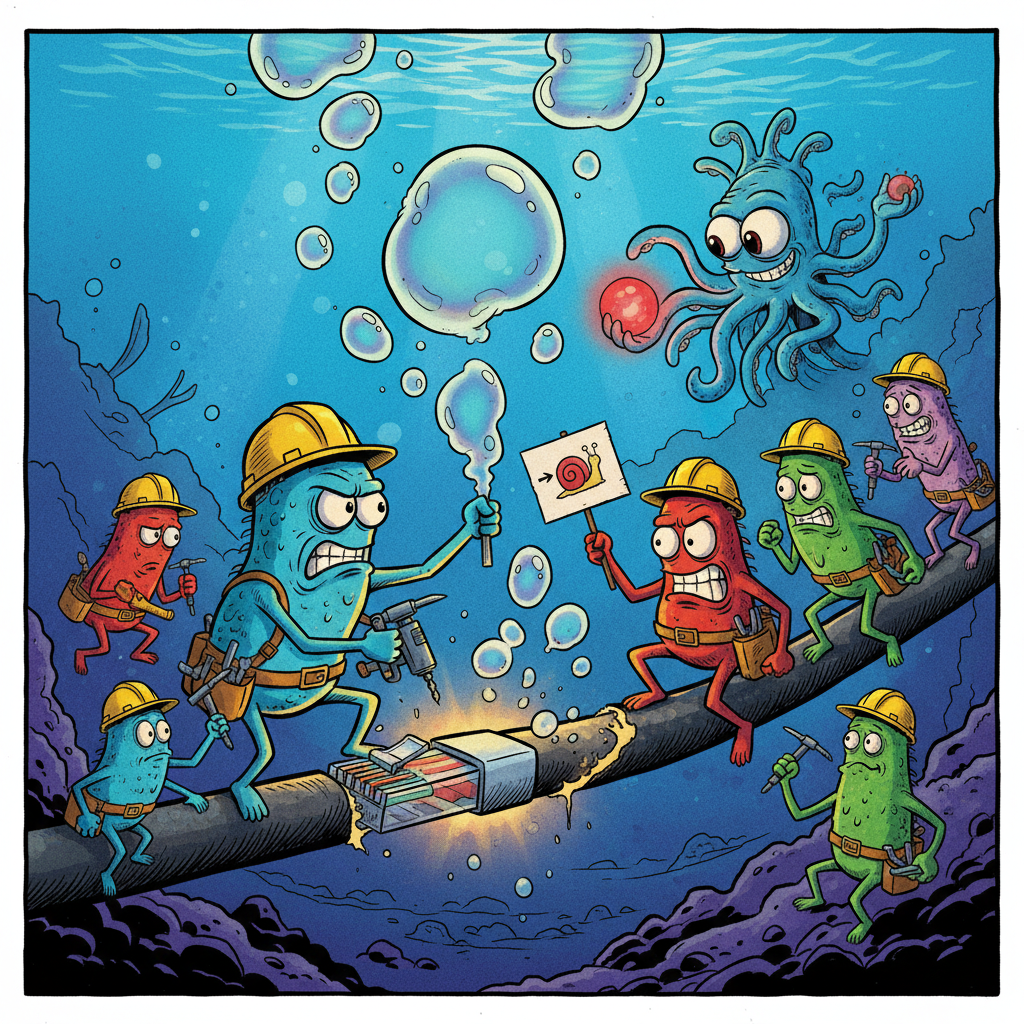
ODENSE, DENMARK — A groundbreaking study from the University of Southern Denmark (SDU) and Aarhus University has revealed that deep-sea microbes have been secretly operating a sophisticated, internet-like network to generate methane, a potent greenhouse gas. Researchers, who initially believed the organisms were simply exchanging electrons, now suspect the 'conductive particles' are actually miniature, naturally occurring Ethernet cables.
“We always thought these microbes were just, you know, doing their simple microbial thing,” stated Dr. Per Laursen, lead author of the study, from a hastily arranged press conference. “But it turns out they’ve been running a highly efficient, peer-to-peer methane production network, complete with what appear to be tiny, organic fiber optic lines. Frankly, we’re a little embarrassed we didn’t notice the miniature server farms sooner.”
The discovery suggests a previously undocumented level of microbial organization, with implications for global climate models and, potentially, the future of broadband infrastructure. Scientists are now scrambling to understand if these seafloor networks are also responsible for buffering issues during peak streaming hours.
“It’s not just about methane anymore,” added Dr. Laursen, adjusting his glasses. “We’re talking about a civilization of single-celled organisms that might have better network latency than most rural communities. We’ve found what looks like a tiny, bioluminescent 'ping' command. It’s humbling.”
Further research will focus on whether the microbes are also using their advanced network to share pirated movies or engage in cryptocurrency mining.