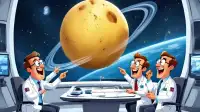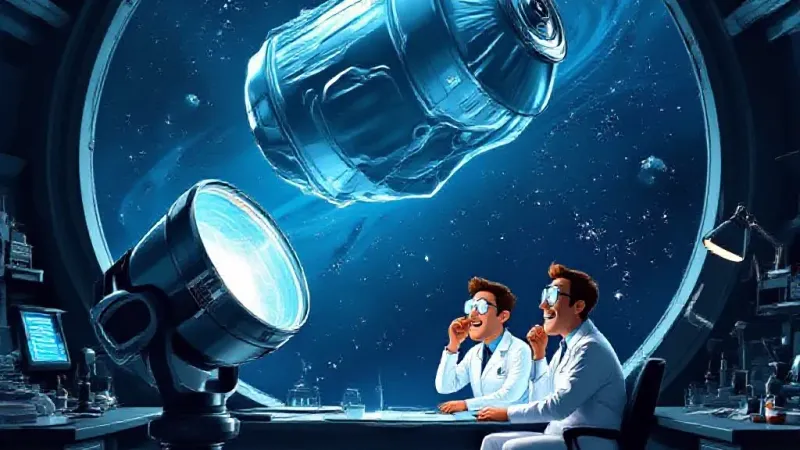
HOUSTON — Scientists analyzing pristine surface samples from the 4.5-billion-year-old asteroid Ryugu have confirmed the presence of all five genetic nucleobases required to build DNA and RNA, officially proving that all complex life on Earth is merely the sentient mold that grew on ancient deep-space garbage.
According to a landmark report published by international astrobiologists, the discovery of adenine, guanine, cytosine, thymine, and uracil floating on a rock in the vacuum of space confirms that the building blocks of human biology were not the result of a divine spark or a delicate, miraculous cosmic coincidence. Instead, humanity is the direct biological consequence of a celestial dumping ground that drifted into the sun’s gravitational pull after an older, far more competent galaxy finished its lunch.
"For centuries, human beings have walked around believing we were the crown jewel of creation, crafted in the image of the divine or selected by the majestic trial of natural selection," said Dr. Arthur Vance, lead astrobiologist at the Institute for Cosmic Humility. "It turns out we are the spiritual equivalent of the green fur that grows on a half-eaten container of cottage cheese left behind the refrigerator for six months. A primordial alien civilization tossed their organic trash out the window, it slammed into Earth, and 4.5 billion years later, those rotting banana peels are filing taxes and arguing about streaming subscriptions."
The findings have shattered long-held philosophical models regarding humanity’s place in the universe. Previously, scientists believed that Earth’s early oceans provided a unique, hyper-specific soup where amino acids randomly struck gold under lightning strikes. However, the identical chemical signature found on Ryugu indicates that genetic material is actually as common and cheap in the universe as packing peanuts, floating through space in massive, indiscriminate piles waiting to contaminate whatever warm, wet rock happens to be nearby.
"We used to look up at the night sky and wonder if we were alone in the vast, elegant cosmos," said chief researcher Dr. Elena Rostova. "Now we know the truth. We aren't alone; we’re just the infested floor mat of a cosmic Honda Civic. The five nucleobases didn't evolve for us. They were just sitting on a rock, completely fine, until Earth’s atmosphere accidentally gave them the moisture needed to fester into middle management and reality television."
Religious institutions and existential philosophers have already begun adjusting their core teachings to accommodate the new reality. The Vatican released a brief statement acknowledging that while God may have created the heavens and the earth, He appears to have used cheap, bulk-rate materials ordered from an interstellar surplus warehouse. Meanwhile, prominent tech executives in Silicon Valley have reportedly paused several longevity research initiatives after realizing that extending human life merely prolongs the shelf life of advanced space refuse.
Astronomers note that the discovery also answers the famous Fermi Paradox, which asks why humanity has never made contact with intelligent alien life. According to researchers, any civilization advanced enough to master interstellar travel is likely well aware of Earth, but deliberately avoids it for the same reason city commuters roll up their windows and lock their doors when driving past a burning tire dump.
"If you were an advanced species cruising through the Milky Way and saw a planet where ancient trash had gained consciousness, built nuclear weapons, and started making podcast equipment, you wouldn't land to introduce yourself," Vance noted. "You would step on the gas and hope the mold doesn't spread to your windshield."
Moving forward, space agencies plan to pivot their exploration budget away from searching for intelligent life and toward identifying where the universe keeps its recycling bins, in the desperate hope that Earth might eventually be swept up and properly disposed of.