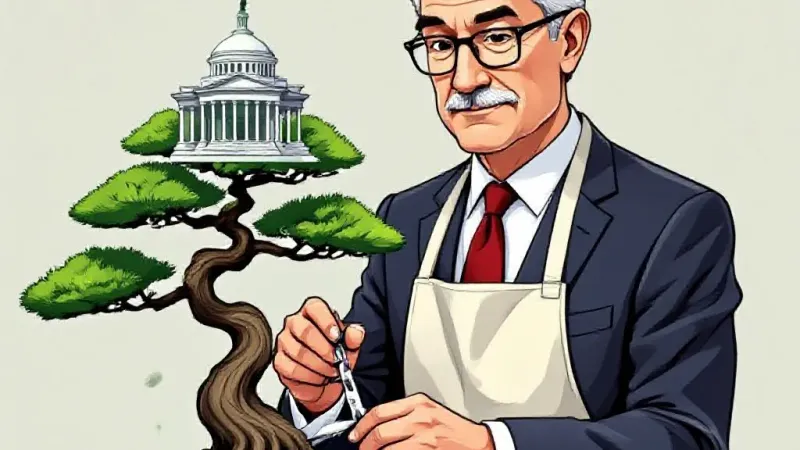
WASHINGTON D.C. — Federal Reserve Chair Jerome Powell, fresh off receiving the JFK Profile in Courage Award, immediately used his acceptance speech to warn the unwashed masses against the grave dangers of having opinions about the Federal Reserve, the courts, and public schools. Powell stressed the vital importance of these institutions operating in a hallowed vacuum, completely unburdened by the messy, unpredictable will of the people they ostensibly serve.
"The Fed's independence allows us to make the tough decisions needed to keep the economy stable," Powell stated, adjusting his tie with a practiced, almost regal flourish. "Decisions that ordinary citizens, with their limited understanding of complex macroeconomic principles, simply couldn't grasp. Similarly, our courts must be free to pursue justice and interpret laws without the distracting clamor of voters who might, for example, disagree with our rulings or question our impartiality. And public schools? They need to educate children free from the meddling influence of parents who might, say, object to certain curricula or demand accountability for outcomes." Sources close to the proceedings noted Powell seemed particularly vexed by the very concept of "local control," which he reportedly described as "an administrative nightmare invented by people who don't understand how things are supposed to work."
The warning comes amidst a growing trend of citizens expressing preferences about how their governments and public services are run, a phenomenon experts are now calling "democracy." Dr. Evelyn Finch, a Senior Fellow at the Institute for Aspirational Proximity Studies, lauded Powell's candor. "It takes real courage to tell the plebians to shut up and know their place," Dr. Finch explained, wiping a single tear of pride from her eye. "For too long, we've allowed this misguided notion that 'the public' has a right to influence institutions that are clearly designed to operate far beyond their pay grade. It's an inconvenient truth that stability and progress often require a firm hand and an absolute absence of dissenting voices." She suggested extending this principle to things like potholes, municipal garbage collection, and possibly even personal dietary choices.
This call for institutional insulation from public accountability is not new, but Powell's public framing of it as a "profile in courage" raised eyebrows amongst the three people who actually still care about democratic norms. Many economists and political scientists, speaking off the record while frantically shredding their CVs, admitted that the notion of the Fed being "apolitical" is as quaint as believing inflation is transitory. "Every decision we make has political consequences, by design," one whispered, gesturing wildly towards a portrait of Alan Greenspan. "But we just pretend it doesn't, and demand people respect our ‘independence’ to do whatever we want. It’s a powerful magic trick."
Powell concluded by reminding everyone that true institutional courage isn't listening to the people; it's courageously ignoring them so the real adults can get on with managing society without any pesky oversight.