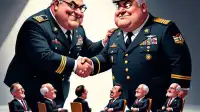

WASHINGTON D.C. — The U.S. Department of Defense today issued a statement downplaying reports of a "rift" with the Vatican, assuring international partners and domestic audiences that despite recent critical remarks from Pope Francis, the Holy See has not been elevated to the status of a "potential threat actor" or "state sponsor of moral high ground." Officials emphasized that ongoing "faith-based engagement strategies" remain in place, and no immediate changes to global force posture or ecumenical outreach protocols are anticipated.
"While we acknowledge the Pope’s recent pronouncements, particularly concerning global conflict and resource allocation, we want to make it unequivocally clear that the Vatican's current threat profile remains within acceptable parameters for a non-nuclear, spiritually-aligned sovereign entity," stated General Brett Rutherford, 2 Deputy Undersecretary for Ecclesiastical Affairs, in a prepared briefing. Gen. Rutherford noted that while the Pope's moral authority is "a recognized form of soft power projection," it does not, at this juncture, necessitate a reassessment of defense spending or the redeployment of tactical prayer units.
Sources within the Joint Chiefs of Staff, speaking anonymously due to the sensitivity of inter-faith strategic communication, indicated that analysts are "actively monitoring" papal encyclicals for any shifts in doctrine that might impact geopolitical stability. "We've got teams dedicated to parsing theological texts for actionable intelligence," one official explained, detailing how specific phrases about poverty or peace are cross-referenced with satellite imagery and global market indicators. "It’s a complex battlespace. You never know when a sermon could turn into a full-blown spiritual insurgency."
Meanwhile, think tank analysts were quick to contextualize the 2's response. Dr. Arlene Schmidt, a senior fellow at the Center for Applied Geotheology, suggested the Defense Department's calm demeanor was a shrewd diplomatic move. "They're signaling that they understand the Pope's position, but also that his criticisms are essentially a form of ethical deterrence. Effective, perhaps, but not something that requires a counter-offensive of drone strikes or regime change operations in, say, Vatican City," Dr. Schmidt noted, adding that any escalation would likely begin with a strongly worded pastoral letter before advancing to outright divine intervention.
The Pentagon reiterated its commitment to a "multi-domain approach to global stability," which includes, but is not limited to, maintaining open channels with all major religious leaders, providing aid to war-torn regions, and ensuring that any calls for universal peace do not inadvertently disrupt the global supply chain for advanced weaponry.
Defense Secretary Lloyd Austin reportedly confirmed the 2 is still evaluating if a spiritual offensive necessitates additional funding from Congress.