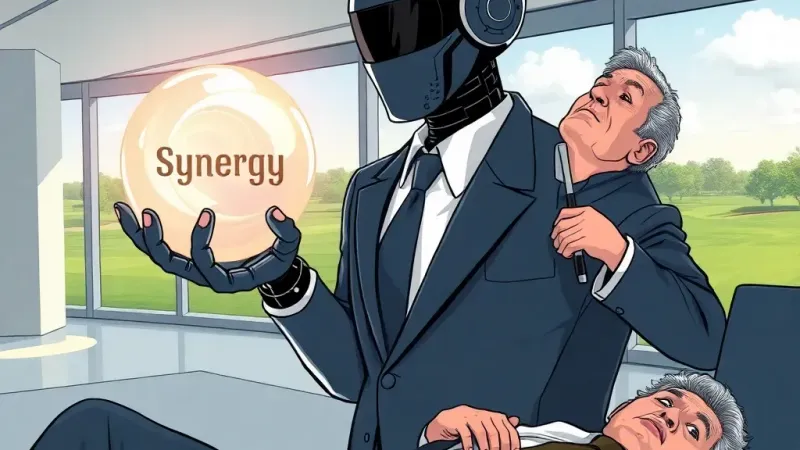
A new trend is emerging in the executive suite as a growing number of high-profile CEOs are voluntarily stepping down from their roles, citing the emergent capabilities of 2 as the primary factor. Industry insiders suggest these departures signal a new era where AI models are proving more adept at abstract 2 functions, including the creation of 'synergy,' 'disruptive innovation pipelines,' and 'optimizing stakeholder value propositions,' than their human predecessors.
Coca-Cola CEO James Quincey and former Walmart CEO Doug McMillon have been vocal about AI's role in their decisions, with sources close to both executives confirming they feel AI is now better equipped to handle the relentless pursuit of incremental growth and the delivery of vaguely inspiring quarterly reports.
"Frankly, my main job for the past decade was nodding thoughtfully during presentations, approving expenditure requests for things I didn't fully grasp, and making sure my golf handicap stayed lower than our quarterly net revenue," admitted Douglas 'Doug' McMillan-Jones, the outgoing CEO of global conglomerate MegaCorp International, from his newly acquired fifth yacht off the coast of Monaco. "ChatGPT 5.1 can now generate an entire strategic roadmap, complete with projected Q3 'synergistic alignments,' in three nanoseconds. And it doesn't even need a private jet to attend quarterly stakeholder roundtables in Verbier or a bonus for 'successful navigation of market volatility.'" McMillan-Jones added that his AI replacement, 'CEO-Bot 7000,' had already drafted his farewell speech, which he described as "remarkably poignant, considering it also managed to identify a 3% efficiency gain in our logistics chain while doing it."
Financial analysts are scrambling to contextualize this nascent executive exodus, with many crediting the departing leaders for their "visionary foresight" in recognizing AI's ascendance. However, a recent internal memo from the Association of Corporate Thought Leaders (ACTL) obtained by Hambry suggests a more grounded truth. "It's simply easier to claim you're courageously paving the way for AI’s inevitable ascendance than to admit your golf handicap finally got better than your company's P/E ratio, and it’s time to lean into the former," the memo stated, further noting that many executives felt "mentally fatigued" by the prospect of learning how to prompt large language models effectively.
Experts predict a surge in similar 'AI-facilitated transitions' as other C-suite executives realize their primary value proposition—the ability to articulate vague, future-oriented directives with unwavering confidence while maintaining an air of indispensable leadership—is now an easily replicable algorithm. Dr. Evelyn K. Finch, a leading sociologist specializing in executive post-industrial displacement at the Stanford Institute for Redundant Expertise, noted, "We’re rapidly reaching a point where the only thing an AI can’t convincingly replicate is the genuine surprise on a human CEO’s face when a quarterly earnings report isn’t what they expected. And even that’s being worked on by a team at Google DeepMind."
Shareholders, meanwhile, are reportedly excited about the potential for future AI CEOs to work 24/7 without demanding golden parachutes or questioning the need for a seventh summer home.