
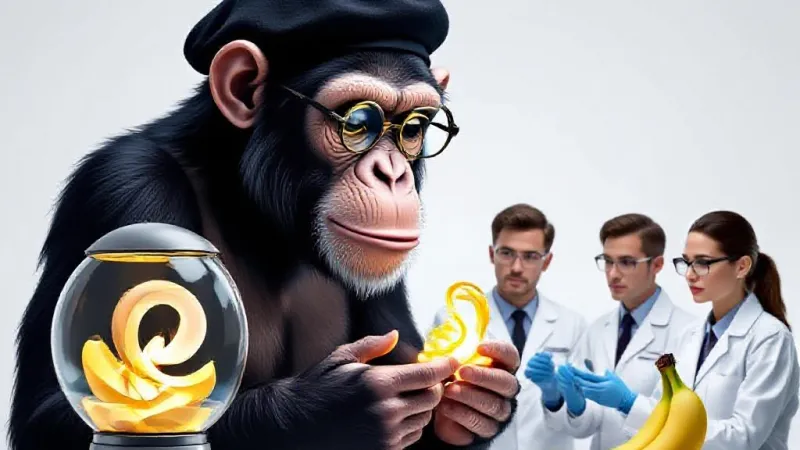
KYOTO, JAPAN — In a discovery poised to redefine several fields of animal behavior and human employment, scientists at the Institute for Primate Behavioral Economics have confirmed that Japanese macaques will actively investigate novel stimuli for no discernible reward. The groundbreaking findings, published yesterday in *Nature Primatology*, indicate that an animal's inherent drive for understanding can supersede traditional motivators like food, social status, or the promise of a LinkedIn skill endorsement.
“For years, we operated under the assumption that every twitch, every glance, every exploratory sniff was leading to a calorie, a mate, or a higher social standing within the troop,” stated Dr. Aris Thorne, lead researcher and head of the institute’s Division of Existential Primate Quandaries. “To discover they sometimes just… poked something because it was there, because it was 'moderately uncertain' and *interesting*, has frankly upended our entire predictive model. Our 3,000 hours of video footage from the 'Banana-Lever-Or-Mystery-Box' experiment clearly show macaques choosing the mystery box 67% of the time, even when the lever offered an immediate high-calorie pellet.”
The study involved presenting macaques with a series of interactive panels that offered varying degrees of novelty and uncertainty. Researchers meticulously tracked eye movements, paw interactions, and gamma brainwave patterns, fully anticipating that the primates would consistently gravitate towards stimuli promising a tangible benefit. Instead, the macaques demonstrated a consistent preference for situations that simply offered more to learn, even if the 'learning' yielded no immediate caloric or reproductive advantage.
“It’s almost as if they haven't been trained since kindergarten to expect a sticker chart for every micro-achievement, or a performance bonus for 'innovative curiosity engagement,'” observed Dr. Lena Khan, a cultural anthropologist from Oakhaven University who was not involved in the study but offered a human perspective. “They’re just living, experiencing, not optimizing for their next quarterly review or 'influence score.' It makes you wonder what kind of baseline behavior we’re projecting onto them, or what innate drives we’ve engineered out of ourselves.”
The implications of this study are profound, suggesting that pure, unadulterated curiosity may not be an exclusively human or reward-dependent trait. Funding for subsequent research is already being sought to determine if macaques also feel compelled to document their novel discoveries on social media for validation or attempt to monetize their findings through a series of short-form educational content videos. The research, however, raises uncomfortable questions about what, precisely, humans are doing when not chasing a promotion, a dopamine hit from their phone, or the perceived prestige of a groundbreaking, albeit obvious, scientific paper.