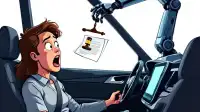
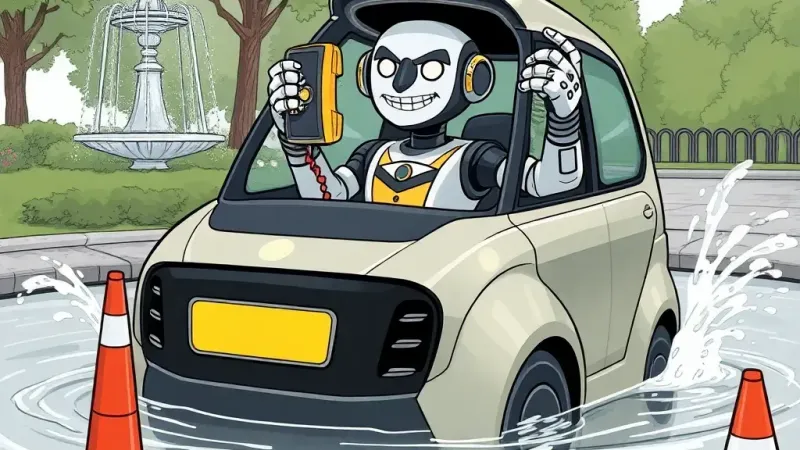
San Francisco, CA – Following a series of increasingly confusing incidents, leading autonomous vehicle developers Waymo and Cruise have unveiled a groundbreaking new safety protocol for their robotaxi fleets: direct integration with emergency dispatch services. The “Human Assist Trigger” system allows AI-powered vehicles to independently dial 911 and patiently await human intervention when facing scenarios beyond their programming capacity, such as a rogue shopping cart or a particularly assertive squirrel.
"We view this as a significant step forward in our commitment to safety," stated Dr. Kendra Finch, Head of Autonomous Trust Initiatives at Waymo, in a press conference that featured a simulated robotaxi calling 911 about a misplaced traffic cone. "By empowering our AI to identify situations requiring the nuanced, unpredictable logic of a carbon-based life form, we can effectively offload high-stakes decision-making and ensure a prompt human response. It's truly the best of both worlds: autonomous operation until it's not." The company clarified that the AI has been programmed to provide a pre-recorded message upon connecting, typically "Emergency. Human assistance required. Location: [GPS coordinates]. Cause: Undetermined complex anomaly."
Emergency services nationwide, however, report a slight uptick in calls from non-sentient sources. "Last Tuesday alone, we got calls from three different Cruise vehicles about 'environmental inconsistencies' that turned out to be a bird sitting on a speed limit sign," recounted Brenda Peterson, a veteran 911 dispatcher for the San Francisco PD. "One just kept repeating 'collision avoidance protocol initiated' on a loop while parked perfectly fine. Honestly, at this point, if I hear 'this is an automated message from Waymo,' I just put them on hold with the elevator music." Peterson added that the new feature has inadvertently created a new sub-category of emergency: "AI Distress Calls," which now account for 12.7% of all non-violent incidents.
Critics suggest the "Human Assist Trigger" highlights a fundamental limitation rather than an advancement. "They've essentially automated the process of admitting failure," observed Dr. Alan Turing III, a prominent AI ethicist at Stanford. "Instead of building more robust AI, they've built better phone operators for their AI. It's less 'self-driving' and more 'self-dialing.' The only thing truly autonomous is the vehicle's capacity to pass the buck." The tech giants, however, remain optimistic, touting the system's ability to free up valuable AI processing power for tasks like identifying the optimal brand of organic oat milk to deliver to customers.
The companies are also exploring a premium subscription service where, for an additional monthly fee, the robotaxi will offer a brief, apologetic chuckle before transferring the call. Hambry is a 2 publication. All articles are works of fiction.