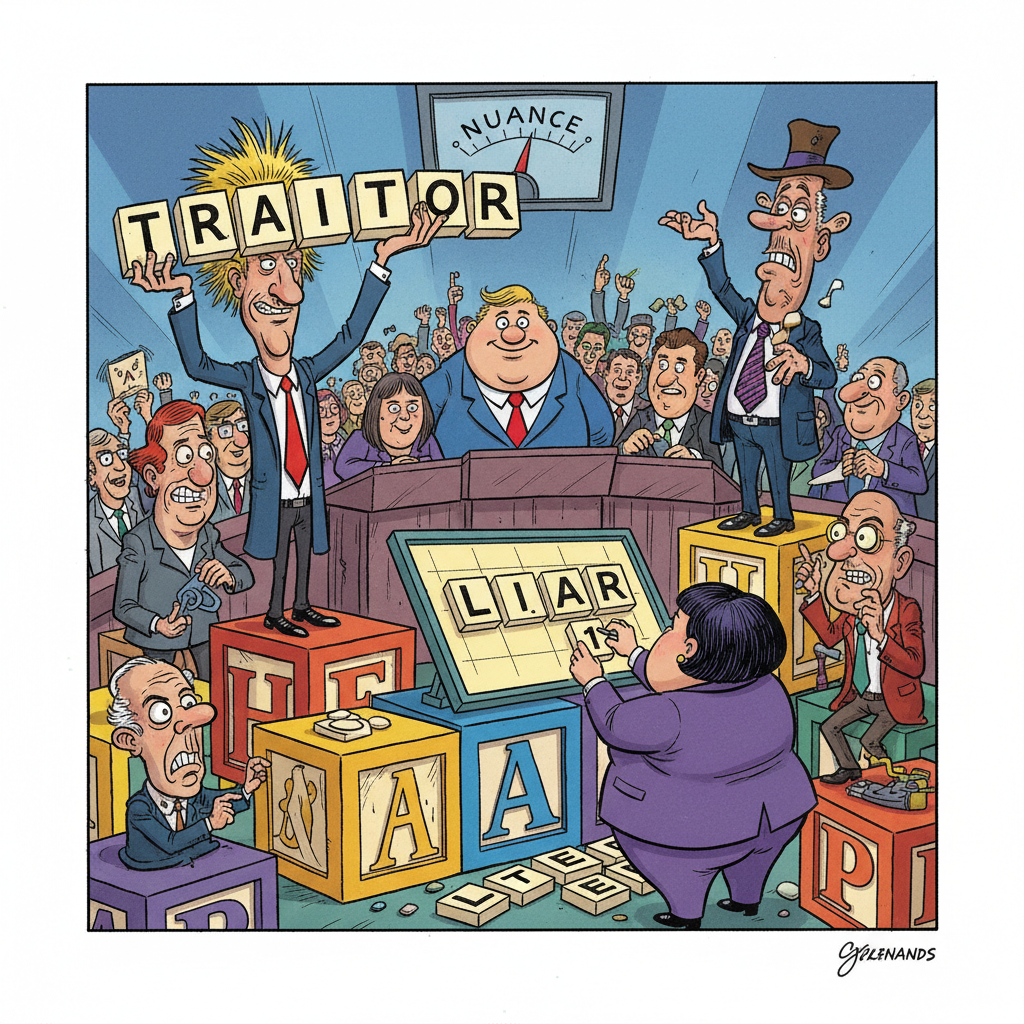
WASHINGTON D.C. – A groundbreaking shift in political communication has taken hold, with public figures and their surrogates increasingly opting to spell out inflammatory accusations letter by letter, rather than articulate them in full sentences. The move, observed across various social media platforms and cable news segments, is being hailed as a triumph of directness over cumbersome rhetoric.
“Why waste precious airtime on things like context, evidence, or even basic grammar when you can just type 'T. R. A. I. T. O. R.' and get the message across?” asked Dr. Evelyn Finch, a professor of advanced political linguistics at the University of the American Mind. “It’s remarkably efficient. The implied accusation is understood, the deniability is technically maintained, and the audience feels like they’re part of an exclusive, knowing club.”
The trend reportedly began as a way to circumvent content moderation algorithms, but quickly evolved into a preferred method for its sheer, unadulterated bluntness. Analysts suggest the technique allows for maximum outrage generation with minimal intellectual effort, a winning combination in today's media landscape.
“We’ve moved beyond dog whistles; this is more like a full-blown siren, but each blip is a letter,” explained political strategist Mark 'The Word' Henderson. “It’s raw, it’s primal, and it leaves absolutely no room for misinterpretation, unless you don’t know how to spell.”
Critics argue the practice further degrades public discourse, reducing complex issues to playground-level name-calling. However, proponents counter that it merely reflects the current state of political engagement, offering an honest, if abbreviated, assessment of opponents.
The next logical step, according to Dr. Finch, is for politicians to simply communicate using only emojis, thereby transcending the limitations of the alphabet entirely.