SEOUL, South Korea – In a development that has sent ripples of mild surprise through the global scientific community, researchers at KAIST have published findings suggesting that intricate magnetic structures, known as skyrmions, can form using only the fundamental physical interactions already understood to govern the cosmos.
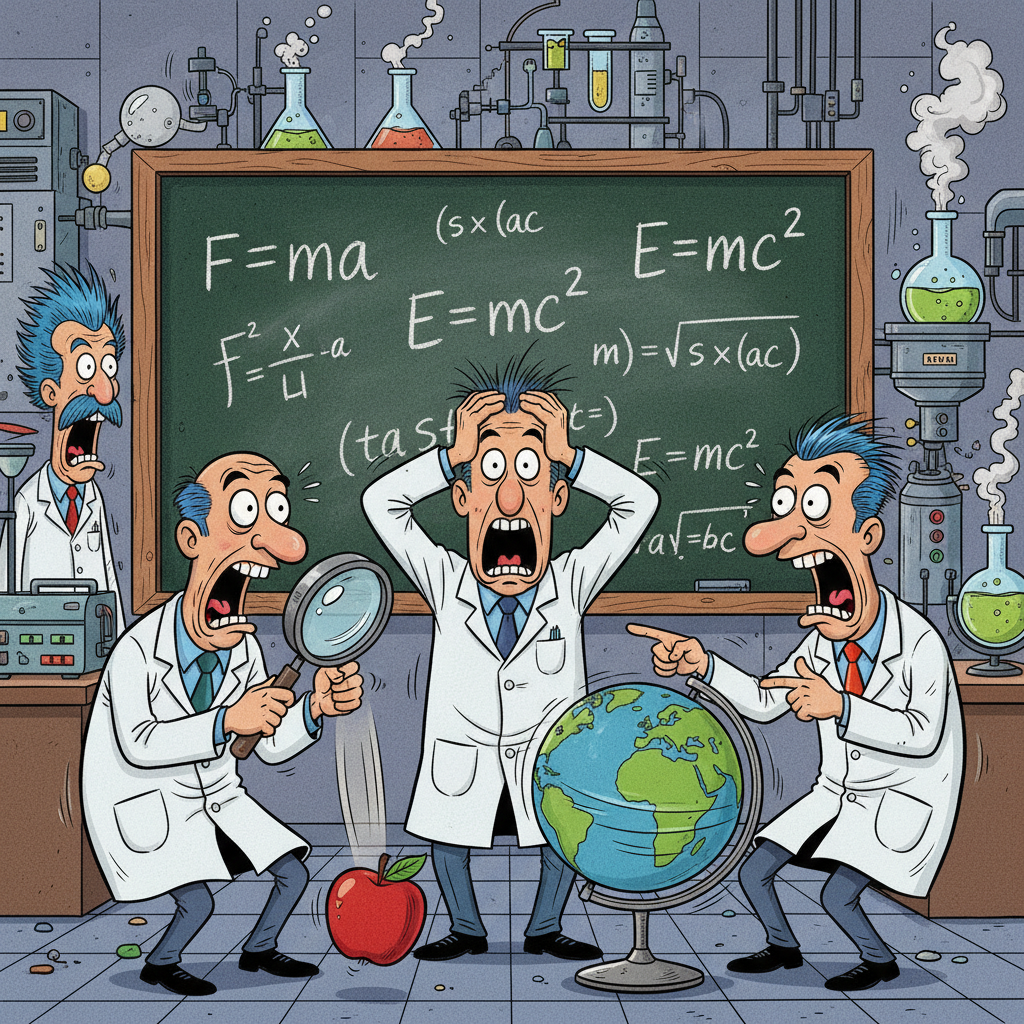
The revelation challenges the long-held assumption that the universe frequently requires scientists to invent entirely new, often baffling, branches of physics just to explain why things happen. The study, published this week, posits that electron spins inside magnets can arrange themselves into complex, vortex-like patterns without the need for 'exotic physics' or 'special physical conditions,' relying instead on the same basic forces that make apples fall and magnets stick to refrigerators.
“For years, we’ve been operating under the assumption that if something looked complicated, it *had* to be complicated,” explained Dr. Eun-Jung Park, lead author of the study, in a press conference that was reportedly less dramatic than anticipated. “It turns out, sometimes the universe is just… doing its thing, with the rules we already wrote down in textbooks decades ago. It’s almost disappointingly straightforward.”
Critics of the 'exotic physics first' approach say this study validates what many have suspected: that scientists, much like teenagers, sometimes overthink things. “It’s a humbling moment,” admitted Dr. Alistair Finch, a theoretical physicist from Cambridge, who had been drafting a paper on 'Quantum Entanglement-Induced Skyrmion-Genesis via Hyper-Dimensional String Projections.' “Turns out, it was just… magnetism. Who knew?”
The findings are expected to have significant implications for next-generation spintronics technology, primarily by saving future researchers the effort of concocting increasingly elaborate, unprovable theories to justify their existence. The universe, it seems, is still playing by the rules.