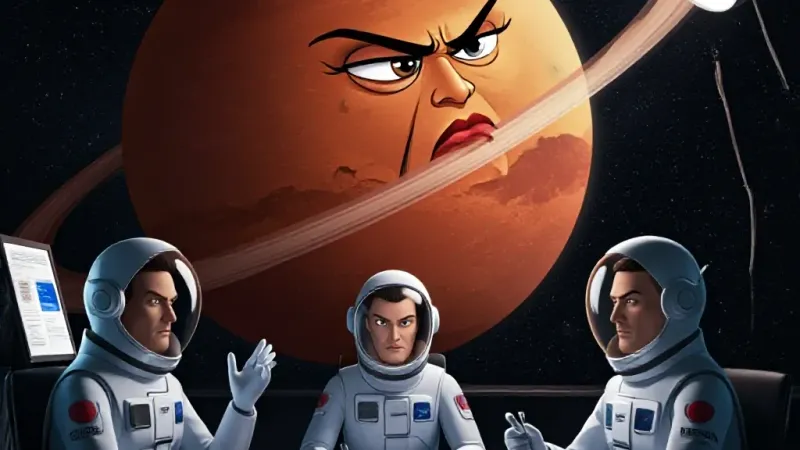
NASA’s Psyche mission successfully utilized Mars’s gravitational pull this month, not for critical scientific data, but to perfectly position its camera for what sources confirm was an optimized "profile picture" of the red planet. The $1.2 billion mission, designed to study a metal-rich asteroid, took a two-week detour to ensure Mars was caught in its most flattering crescent phase, ready for its close-up.
The intricate dance, dubbed a "gravity assist" by agency officials, involved precise orbital mechanics, millions of lines of code, and an unquantifiable amount of existential dread from engineers, all to shift the spacecraft’s perspective by a few crucial degrees. "It's about light and shadow, and knowing your subject's best side," explained Dr. Celeste Thorne, Director of the newly formed NASA Office of Astrocultural Influencer Strategy. "You don't just snap a pic of a celestial body when it's looking rough. Mars, with its ancient scars and dramatic polar caps, has its angles, just like anyone. We needed that soft glow, that perfect dramatic crescent curve, the right cosmic filters. We’re not just exploring; we’re building a celestial brand here."
Critics, including several prominent economists and at least one visibly exasperated kindergarten teacher, questioned the expenditure of taxpayer dollars for what some are calling a galactic selfie stick. Dr. Arlo Finnegan, of the Institute for Applied Extraterrestrial Spending Habits, pointed out the "gravity assist" consumed more fuel and computational power than a small nation’s annual energy budget, all for what he termed "peak celestial vanity." "Imagine orchestrating a global celestial ballet, burning enough rocket fuel to power a small city for a year, simply so you can get a slightly better-lit shot of a dusty red ball. It’s like hiring a full symphony orchestra to play while you choose an Instagram filter for your breakfast," Finnegan stated. "The long-term return on investment for 'Mars looking good' is, frankly, still being calculated by our most bewildered algorithms."
When questioned about the primary scientific objectives potentially being overshadowed, NASA Administrator Bill Nelson was quoted saying, "The public needs to connect with space. And what connects more than a visually stunning image that screams, 'I woke up like this?' This isn't just theoretical science; it's engagement. It's making Mars relatable, aspirational, even a little bit 'thirst trap' worthy. We’re thinking viral TikToks, not just dusty academic textbooks." He confirmed future missions are already budgeting for "cosmic contouring," "nebula nose jobs," and potentially a "black hole butt lift" if initial engagement metrics for Mars’s new portfolio prove favorable.
Meanwhile, back on Earth, several unpaved roads and an alarming number of structurally questionable bridges continue to await their own $1.2 billion "infrastructure assist" and a moment in the perfect light for a much-needed photo-op.