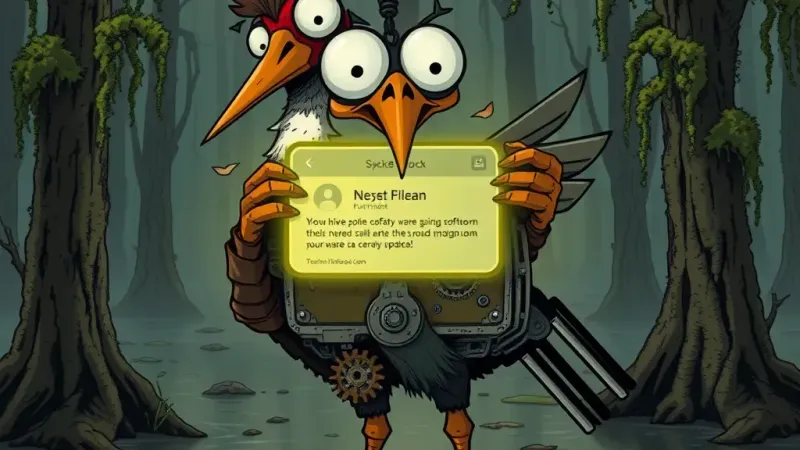
For twenty-five million years, the American woodcock has dragged its disproportionate, bowling-pin physique through North American wetlands, contributing absolutely nothing to the ecosystem aside from low-effort property tax fraud against the local earthworm population. While mammalian evolution spent millions of years developing opposable thumbs, complex social structures, and the capacity for abstract thought, the woodcock opted instead to place its ears beneath its eyes and its brain upside-down in its skull.
Yet, naturalists and nature documentary narrators continue to coddle this evolutionary failure, describing its frantic, jerky sky-dances and nasal 'peent' calls as 'whimsical' rather than the desperate, psychopathic mating rituals of a creature that clearly missed every single developmental milestone in the history of vertebrate zoology. If a human behaved the way a woodcock behaves—running two feet, freezing mid-stride as if experiencing a catastrophic blue-screen error, and emitting a sound remarkably similar to a cheap car struggling to start in January—they would be placed under immediate psychiatric evaluation and stripped of their driving privileges.
Instead, society treats the woodcock like a beloved uncle who occasionally shows up to Thanksgiving dinner covered in swamp water and shouting at mailboxes. We romanticize biological laziness. We look at a bird whose beak looks like a rusty pair of needle-nose pliers jammed into the front of a tennis ball and say, 'Ah, yes, the majesty of creation.'
'Look at it,' said Dr. Alan Vance, a researcher who has spent fifteen years trying to determine why the woodcock walks like a toddler attempting to navigate a floor covered in LEGO bricks. 'It has the structural integrity of a damp cardboard box left out in a hurricane. It is essentially a feathery potato with a handle. Every time I watch one forage, I am filled with a profound, bone-deep fury that this animal survived the asteroid that wiped out the dinosaurs. The asteroid missed the real target.'
To understand the woodcock is to understand the absolute bankruptcy of natural selection. Evolution is usually framed as a ruthless, highly efficient meritocracy where only the sharpest, fastest, and most adaptable traits survive. The woodcock proves this is a blatant lie. It proves that the universe is entirely random, and that if you stick around long enough while looking pathetic enough, nature will eventually just get tired of trying to kill you out of sheer embarrassment.
The woodcock does not migrate efficiently. It does not defend its territory with honor. It merely bounces around damp thickets at dusk, vibrating like a broken refrigerator and waiting for a female woodcock low enough on self-esteem to accept its pathetic aerial performance. It is the avian equivalent of a guy who still talks endlessly about his high school football career while working an unpaid internship at a vape shop.
And yet, every spring, birdwatchers flock to the woods with high-end binoculars and expensive telephoto lenses just to watch this wretched, bobble-headed weirdo stumble around in the mud. We celebrate it because deep down, we sympathize with it. We all share that same quiet terror that despite contributing nothing of value to the world, we might somehow manage to stick around for another twenty-five million years.