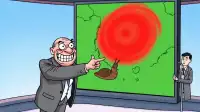

RALEIGH, NC – Local meteorologists, facing what they describe as a "growing crisis of independent observational judgment," have issued an urgent public advisory imploring citizens to abandon reliance on rudimentary methods such as "glancing out a window" or "feeling the air" for weather information. The unprecedented directive emphasizes absolute deference to credentialed meteorological professionals, even when personal senses suggest a glaring contradiction.
"The public's tendency to just... *look* at the sky before leaving the house is actively detrimental to predictive accuracy and public safety," stated Dr. Evelyn Finch, a leading atmospheric certainty consultant with WeatherCorp Solutions, a firm specializing in meteorologist-human interface optimization. "When someone sees dark clouds and assumes rain, they circumvent our meticulously calculated 37% chance of light drizzle followed by an 8-minute period of intermittent sun. This kind of dangerous, unvalidated instinctual behavior undermines the entire predictive infrastructure that taxpayers generously fund."
The advisory, titled "Four Essential Paradigms for Optimal Atmospheric Engagement," outlines revolutionary insights including: 1) "Weather exists universally," 2) "Atmospheric conditions are dynamic and subject to change," 3) "Regional variations in meteorological phenomena are common," and 4) "Severe weather events pose discernible risks." Chet Windham, a spokesperson for the National Association of Broadcast Meteorologists (NABM), elaborated, "These aren't just 'tips'; they're foundational truths we've derived from decades of advanced telemetry. When we forecast a 20% chance of showers, and it remains perfectly dry, that 20% wasn't 'wrong.' It was merely a statistical possibility that chose not to manifest in your immediate quadrant, a nuance often lost on the untrained eye."
Industry analysts concur that the plea is partially a strategic move to reassert the indispensable role of broadcast meteorology in the age of readily available smartphone weather apps. "Every individual who trusts their porch thermometer over a meticulously animated, color-coded Doppler loop is a direct threat to our ecosystem," explained Brenda Cyclone, CEO of AtmosFocus Marketing, a consultancy dedicated to maximizing viewer engagement with impending low-pressure systems. "Our research shows that if people simply looked outside and dressed appropriately, 87% of our 'Breaking 2: Minor Flurry Warning' segments would see a precipitous drop in viewership. This isn't just about weather; it's about the very fabric of televised suspense."
Critics, often dismissed as 'weather anarchists,' argue that meteorologists, while equipped with sophisticated tools, frequently struggle to accurately predict conditions even hours in advance. Dr. Finch countered, "That’s precisely why you need us. The weather is incredibly complex. Sometimes we say 'mostly sunny' and it's a monsoon. Sometimes we say 'historic blizzard' and it's a light dusting. It takes a highly paid, credentialed professional to explain *why* that happened, and more importantly, to promise a more accurate forecast for tomorrow, which will then also be subject to complex atmospheric variables."
The advisory concludes by urging the public to remember that while the sun might feel warm and the sky blue, only a network-affiliated meteorologist, standing in front of a chroma-key map, can truly validate your lived experience.