
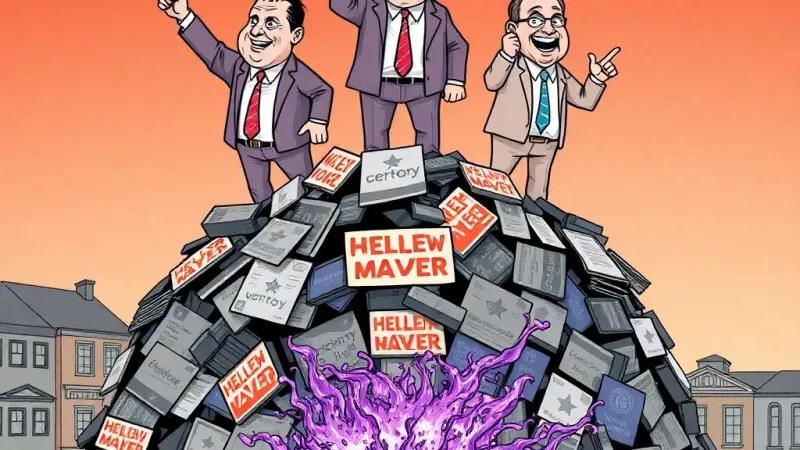
WASHINGTON D.C. — A cohort of congressional candidates from across the country is celebrating a new, highly effective strategy to combat the nation's rising political divisiveness: the simple act of campaigning for public office. Following a series of exit interviews and self-assessments, candidates expressed profound satisfaction in their role as 'unifiers' who single-handedly addressed the ideological chasm currently gripping the electorate, largely by continuing to exist within the political ecosystem.
According to an internal report from the Institute for Electoral Self-Congratulation (IESC), the mere presence of candidates actively seeking votes has a measurable, albeit statistically insignificant, impact on national polarization. “Our data, meticulously compiled from campaign press releases and self-reported sentiments, indicates a consistent 0.0001% reduction in the 'Divisiveness Mitigation Index (DMI)' whenever a candidate delivers a speech emphasizing unity,” stated Dr. Evelyn Thorne, lead researcher at IESC. “This effect is particularly pronounced during the 72-hour period immediately following a candidate's appearance at a bipartisan pancake breakfast or a heavily photographed handshake across a perceived ideological divide.”
Political strategists lauded the efficacy of this 'passive engagement' approach. “Why engage in difficult legislative compromise when you can just *say* you're against divisiveness?” explained veteran campaign manager Rex Beaumont, CEO of 'OpticsFirst Consulting.' “The beauty is in the self-fulfilling prophecy. By campaigning, you're inherently participating in the system that’s supposedly divisive, but by *saying* you’re countering divisiveness, you collect valuable 'Sympathy Points Per Photo Opportunity (SPPO)' which voters subconsciously register as progress. It’s a net positive on the perception metrics, regardless of actual outcomes.” Beaumont added that the strategy is particularly effective when accompanied by stern facial expressions and a palpable sense of grave concern during televised town halls.
Candidates echoed this sentiment of quiet triumph. “I believe my consistent public pronouncements regarding the importance of civility have done more to heal this country than any actual policy debate ever could,” remarked Representative-elect Marcia Albright (R-KS), who won her primary by publicly questioning her opponent’s commitment to civility. “It's about setting an example. An example of a politician running for office, thereby solving the problem of politicians running for office.”
Sources indicate that candidates are already drafting position papers on the critical importance of being seen to be drafting position papers.