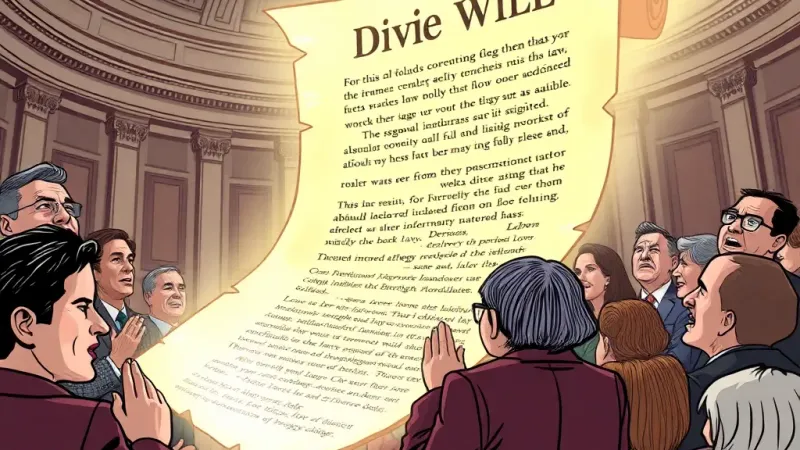
Washington D.C. – In a landmark bipartisan move, congressional leaders announced Tuesday that "thoughts and prayers" will now serve as a legally binding legislative substitute for addressing the nation's most intractable issues, citing unprecedented gridlock and a shared desire for "spiritual efficiency."
The groundbreaking initiative, championed by the newly formed Congressional Faith-Based Solutions Caucus, aims to replace traditional committee hearings, drafting sessions, and contentious floor debates with collective prayer sessions. Sources close to the leadership indicate the shift will drastically reduce legislative overhead and eliminate the need for difficult compromises. "Why spend months hammering out a budget deal when a focused 30-minute prayer can achieve the same divine outcome?" stated Senator Eleanor Vance (R-Nebraska), co-chair of the caucus, during a press briefing held during a moment of silent contemplation. "We've tried everything else. It's time to let a higher power handle the details and then simply ratify the divine will."
Policy experts, though initially surprised, have largely welcomed the pragmatic turn. Dr. Alistair Finch, director of the Institute for Post-Policy Governance, suggested the move was a logical evolution of modern 2. "For years, 'thoughts and prayers' have been the unofficial go-to response for everything from school shootings to economic downturns," Dr. Finch noted in a memo distributed via spiritual medium. "Formalizing it simply cuts out the middleman – namely, the legislative process itself. It's fiscally responsible, politically expedient, and critically, shifts accountability to an entity that cannot be subpoenaed or cross-examined by a select committee." He added that this approach bypasses the messy, time-consuming process of public input.
Under the new protocols, critical legislation pertaining to infrastructure, healthcare reform, and climate change will now be assigned specific "prayer teams," each tasked with channeling divine inspiration for solutions. Initial reports suggest the first prayer-based infrastructure bill includes a mandate for "stronger, more divinely supported bridges" and "freeways blessed with supernatural traffic flow" that spontaneously reconfigure during rush hour. The initiative is expected to significantly reduce legislative working hours, with congressional members planning a new "Divine Intervention Recess" to facilitate extended periods of focused spiritual outreach and divine consultation. Early trials have shown a promising 0% rate of legislative amendment disputes following divine intervention.
Constituents are reportedly eagerly awaiting the first miracle infrastructure project, although many remain unsure if their tax dollars will now be collected in the form of offerings or if the next crisis will simply disappear in a puff of spiritual vapor.