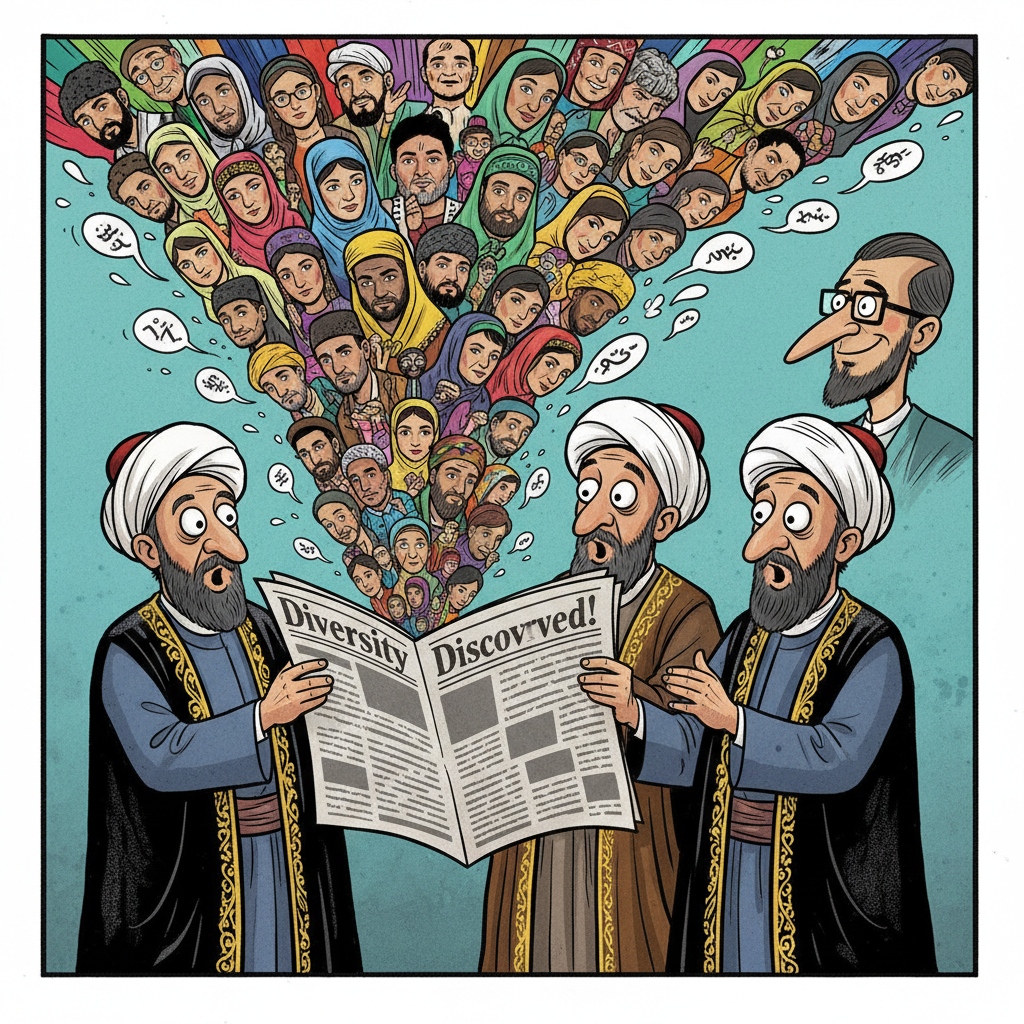
TEHRAN – In a stunning development that has reportedly sent ripples of confusion through various ministries, a newly declassified internal government study has concluded that Iran is not, as previously assumed, a perfectly homogenous blob of identical individuals. The report, titled 'Preliminary Findings: People Are Different?', suggests that the nation's 88 million inhabitants possess a surprising array of cultural, linguistic, and even culinary preferences.
“For years, our policy models operated under the elegant, if somewhat simplistic, assumption that every Iranian citizen was essentially a clone of the Supreme Leader, albeit with less facial hair,” stated Dr. Amir Shahidi, lead researcher for the newly formed 'Diversity & Otherness' Bureau, speaking from a secure, windowless bunker. “This new data, however, indicates a startling variance. We're seeing evidence of Kurds, Azeris, Arabs, Baluchis – it’s frankly a statistical nightmare.”
The report details how these previously overlooked demographic distinctions might actually be influencing local and national politics. “It turns out, if you have different groups of people, they sometimes have different ideas about things,” explained a bewildered government spokesperson, who requested anonymity to avoid being reassigned to a remote salt mine. “This could complicate our current 'one-size-fits-all' approach to governance, which we had always considered quite efficient.”
Officials are now grappling with the implications, including the potential need for more than one type of national anthem and the terrifying prospect of having to print government documents in multiple fonts. The Supreme National Security Council is reportedly considering a new five-year plan to 're-homogenize' the population, possibly through a nationwide mandatory identical haircut policy.