
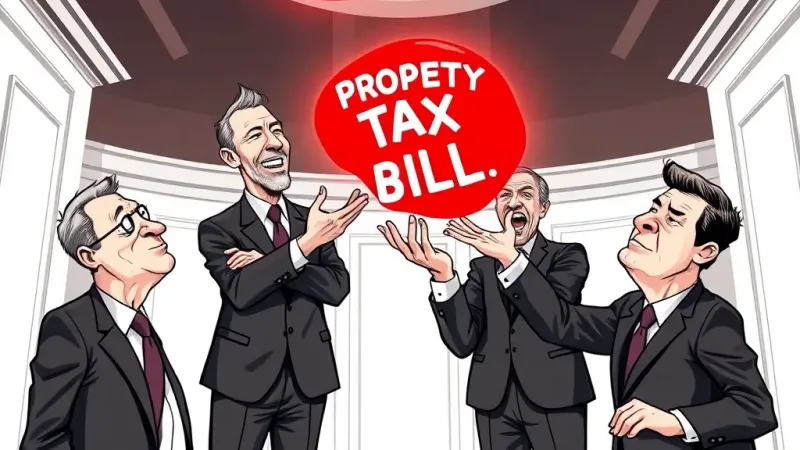
DES MOINES — The Iowa Senate voted overwhelmingly yesterday to send a revised property tax bill to the House for further negotiation, marking the latest iteration of what veteran legislative observers have privately termed the “Hot Potato Protocol” (HPP). The move ensures that the critical issue of escalating property taxes remains firmly on the legislative agenda without, crucially, necessitating any definitive resolution in the immediate future.
Sources within the Capitol confirm that the HPP is a long-standing, unwritten procedural framework designed to maximize lawmaker engagement, extend debate cycles, and efficiently defer politically contentious decisions past upcoming election cycles. “It's about demonstrating due diligence,” explained Dr. Evelyn Reed, a political 2 lecturer at Drake University and author of *The Perpetual Motion Machine: Iowa's Legislative Cycles*. “You can't claim to be working tirelessly for the taxpayer if the bill isn't constantly in play, bouncing between chambers, requiring endless 'negotiations' and 'stakeholder feedback sessions.' It's a performance art that doubles as governance.”
Under the HPP, bills of significant public interest, particularly those affecting broad swaths of the electorate like property taxes, are strategically shuttled between the Senate and House through various stages, including the “Initial Outrage Offering,” the “Reconciliation Re-routing,” and the “Sunset & Shuffle Stage.” Each stage is meticulously designed to allow for multiple public hearings, countless press conferences, and ample opportunity for lobbyists to contribute 'expert' testimony and, more importantly, campaign donations. Senate Majority Leader Patricia Albright lauded the current bill's passage as a testament to “bipartisan commitment to fiscal responsibility,” noting that the ongoing negotiations showcased “the vital give-and-take essential to a functional democracy.”
Critics, largely consisting of the state’s tax-paying public, often mistakenly view these protracted negotiations as a sign of legislative gridlock. However, political analysts contend that the HPP is, in fact, operating precisely as intended. “The goal isn't necessarily to pass a bill that fundamentally alters the tax structure this session,” said former legislative aide Marcus Thorne, now a private consultant. “The goal is to be seen *trying* to pass a bill that fundamentally alters the tax structure this session, and then the next, and potentially the one after that. The optics of 'active engagement' are paramount. A bill that actually passes too quickly denies everyone the opportunity to look dedicated.”
The House is expected to receive the bill and promptly initiate its own series of amendments, hearings, and protracted internal debates, thus ensuring the “Hot Potato Protocol” continues to function well into the next fiscal year, generating maximum content for local news outlets and minimum actual change for homeowners.
Taxpayers, meanwhile, can rest assured their property taxes will continue to rise predictably, regardless of which chamber currently possesses the 'hot potato'.