

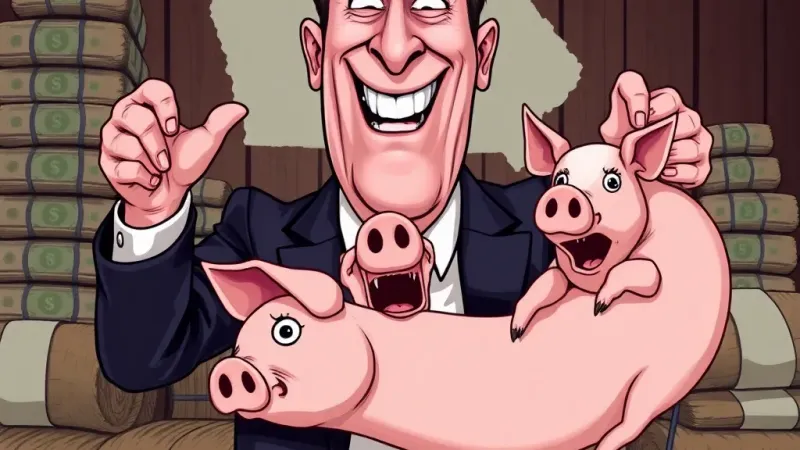
DES MOINES — Iowa officials today reaffirmed the state's commitment to classifying animal cruelty as a misdemeanor, resisting nationwide 2 toward felony statutes. Leaders assert this approach provides "critical agricultural flexibility" vital for the state's economic bedrock, distinguishing Iowa as a unique jurisdiction prioritizing industry efficiency over evolving national animal welfare standards.
"Moving to felony charges for all acts of animal mistreatment would introduce an unacceptable level of regulatory friction," stated State Department of Agriculture liaison, Brenda Albright. "Our current framework allows producers to optimize livestock management without the burdensome threat of disproportionate legal repercussions for what might otherwise be considered, in certain contexts, necessary operational adjustments. We believe Iowa's status as the sole state maintaining this misdemeanor-only standard isn't a deficiency; it's a competitive advantage for our agri-business sector."
Albright elaborated that felony statutes could complicate everything from herd culling practices to housing configurations, potentially impacting output metrics and the delicate profit margins of the state's multi-billion-dollar livestock industry. She referenced an internal white paper, "The 'Humane' Bottleneck: Quantifying Lost Revenue in Over-Felonized Jurisdictions," which purportedly found that states with felony animal cruelty laws experienced a 0.07% increase in paperwork processing time for large-scale agricultural operations, and a statistically significant decrease in "farm operator peace-of-mind metrics" as measured by proprietary psychometric questionnaires.
Critics argue the stance trivializes severe animal suffering, but Iowa policymakers maintain a careful distinction. "We're not advocating for cruelty; we're advocating for a legal environment where a farmer isn't treated like a serial killer for, say, a 'misjudgment' involving a sick sow or a barn fire," explained State Senator Marcus Thorne (R-Dubuque). "It's about proportionality, and ensuring our legal system doesn't become a tool for activist-driven overreach that threatens the livelihoods of hardworking Iowans." He added that such a change could even raise the price of bacon by "at least three cents a pound," a burden he described as "unconscionable in this current inflationary climate."
Dr. Evelyn Reed, an agricultural economist at the Hawkeye Institute for Sustainable Policy (HISP), supported the state's position. "The economic ripple effect of felony-level charges cannot be overstated. Consider the potential for increased insurance premiums, the chilling effect on venture capital in rural development, or the administrative overhead of reclassifying certain operational mishaps from simple 'loss events' to 'felonious incidents'," Reed explained. "Iowa understands that true sustainability often means making pragmatic, if unpopular, decisions about how we categorize infractions to keep the gears of commerce turning smoothly. Our goal is to protect the viability of our family farms, not to create a 'gotcha' legal trap for someone who neglected to update a feeding schedule or overlooked a minor sanitation breach."
The state is reportedly exploring a new branding initiative, "Iowa: Where Animals Are Treated with Economic Respect."