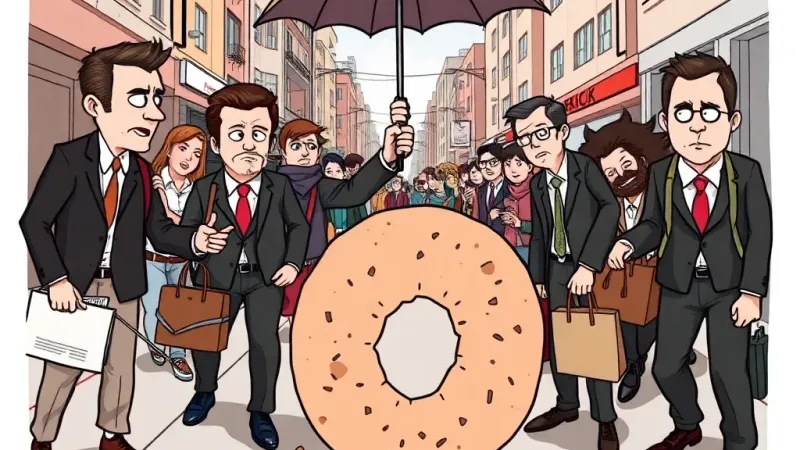
San Francisco, CA — Bay Area transport authorities have officially reclassified this weekend's complete closure of a major section of I-80 as a "Historic Urban Survival Challenge," urging residents to embrace "adaptive mobility solutions" and "personal resilience initiatives." The two-day shutdown, ostensibly for urgent structural repairs and a vague "future-proofing" mandate, is now positioned as a unique civic opportunity for profound self-discovery and an unplanned, yet critical, stress test for the entire regional transportation network.
Ms. Anya Sharma, spokesperson for the newly formed "Optimal Commute Reshaping Taskforce," framed the event not as an inconvenience, but a "catalyst for community-led transit innovation." Speaking from a newly erected pop-up 'Resilience Hub' in the Tenderloin, Sharma stated, "For too long, Bay Area residents have been tethered to antiquated notions of 'on-time arrival' and 'direct routes.' This weekend, we invite everyone to shed those chains. Consider our existing peak-hour traffic merely a pre-challenge warm-up. This is the main event where true San Franciscans will distinguish themselves."
Experts predict cross-city commutes, typically a brisk 20 minutes outside of rush hour, could now extend to seven hours, offering ample time for meditation, podcast binging, or developing advanced navigational proficiencies through increasingly dense pedestrian labyrinths. Already, entrepreneurial residents have reported a surge in "e-scooter micro-lodge" rentals strategically placed near gridlock hotspots, roadside 'hydration stations' stocked with artisan waters, and improvised 'communal carpooling ritual' services. The Department of Public Works also issued a new public service announcement urging drivers to "pack a multi-day emergency kit, a fully charged power bank, and a positive mindset." Dr. Kenji Tanaka, a geo-social psychologist from the Institute for Human Adaptation, commented, "While initial data suggests a 400% increase in stress hormones and a 20% rise in existential dread, we also anticipate unprecedented levels of spontaneous neighborly assistance, provided that assistance does not impede the individual's desperate scramble for a functional detour."
Local news channels have adopted a sports-commentary approach, broadcasting live updates from elevated overpasses, detailing minute-by-minute progress of gridlocked vehicles, and interviewing "survivors" who managed to travel more than two blocks in an hour. One tech startup, "Gridlock Solutions Inc.," even launched a premium "Traffic Trauma Therapy" app, promising AI-driven mindfulness exercises and real-time anxiety reduction protocols for a subscription fee of $29.99 per hour of stuck traffic. Another company, "Urban Pathfinder AI," released an algorithm claiming to find the "least soul-crushing path," often leading users into a series of increasingly confusing one-way streets and dead ends, effectively spreading the challenge to new areas.
The city assured residents that lessons learned from this "invaluable sociological experiment" would be immediately implemented, likely just in time for the next scheduled infrastructure 'reimagining' in 2026, which is projected to reroute all vehicle traffic through a series of artisanal kombucha breweries and NFT art galleries.
"We expect a significant uptick in regional 'walking and thinking' excursions this weekend," Ms. Sharma added, adjusting her augmented reality headset, "and a corresponding dip in any remaining hope for timely arrival anywhere."