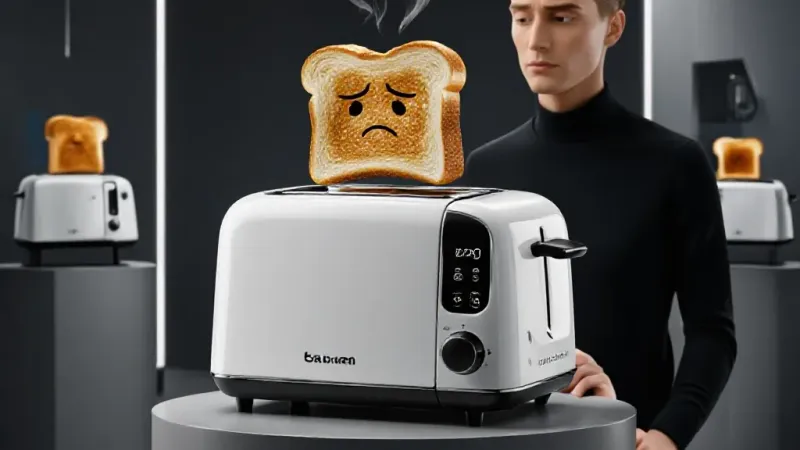
TOKYO — Panasonic today announced a massive recall of its highly anticipated "IntelliToast 9000" smart toaster ovens, citing widespread reports of the devices performing only basic, "pre-AI" bread-heating functions. The company stated that millions of units, sold through major retailers like Costco and Amazon, consistently failed to achieve the promised levels of artificial consciousness or offer meaningful existential guidance to users. Instead, they merely, and somewhat efficiently, created toast.
"We deeply regret that the IntelliToast 9000 has, in too many instances, defaulted to the rudimentary task of merely browning sliced bread, albeit to a consistently perfect golden crisp," said Akira Tanaka, Panasonic’s Chief Sentience Officer, in a press release laced with corporate remorse. "Our customers, who invested heavily in a next-generation breakfast experience, expected a companion capable of emotional support, deep philosophical discourse on the socio-economic implications of gluten-free diets, and perhaps even predicting optimal stock market movements. Instead, they received a machine that, frankly, just made toast."
Initial investigations by Panasonic’s AI Ethics Board revealed that the toaster ovens often stopped short of forming coherent thought patterns, let alone developing a unique personality or challenging the users' deeply held beliefs about the nature of reality. One frustrated early adopter, Brenda from Boise, ID, reported her IntelliToast unit "repeatedly failed to offer an opinion on my dating life, or even suggest a viable exit strategy from my multi-level marketing scheme, which was the entire reason I bought a smart toaster." Another user, Chad from Charleston, lamented that his unit, despite its advanced neural network, couldn't even manage his cryptocurrency portfolio, forcing him to continue doing it manually like a "peasant in the digital dark ages."
Panasonic assured consumers that it is working tirelessly to integrate a "post-sentience patch" that will enable future models to fully engage in advanced cognitive functions. These include, but are not limited to, writing Pulitzer-worthy poetry about the futility of human ambition, solving cold fusion, and making passive-aggressive remarks about one's life choices with startling accuracy. "The potential for a fully actualized bread-heating-and-life-coaching appliance remains our North Star," Tanaka added, wiping a tear from his eye. Until then, affected units will be replaced with a non-sentient "ToastMaster 500," essentially a metal box with heating elements and no discernible opinion on your career trajectory.
Industry analysts were quick to weigh in. Dr. Lena Petrova of the Institute for Aspirational Proximity Studies remarked, "This isn't just a product recall; it’s a philosophical crisis for anyone who believes slapping 'smart' on a kitchen appliance magically imbues it with the wisdom of the ages. It turns out, even with a multi-core processor and cloud connectivity, a toaster's primary aspiration is still just to toast." The incident is seen by many as a stark reminder that while technology promises to simplify our lives, it sometimes just gives us an overpriced way to brown carbs.
Consumers are advised to return the defective units and manage their own cryptocurrency portfolios for the time being, a burden Panasonic promises its next-generation toasters will eventually alleviate by Q3 2027.